

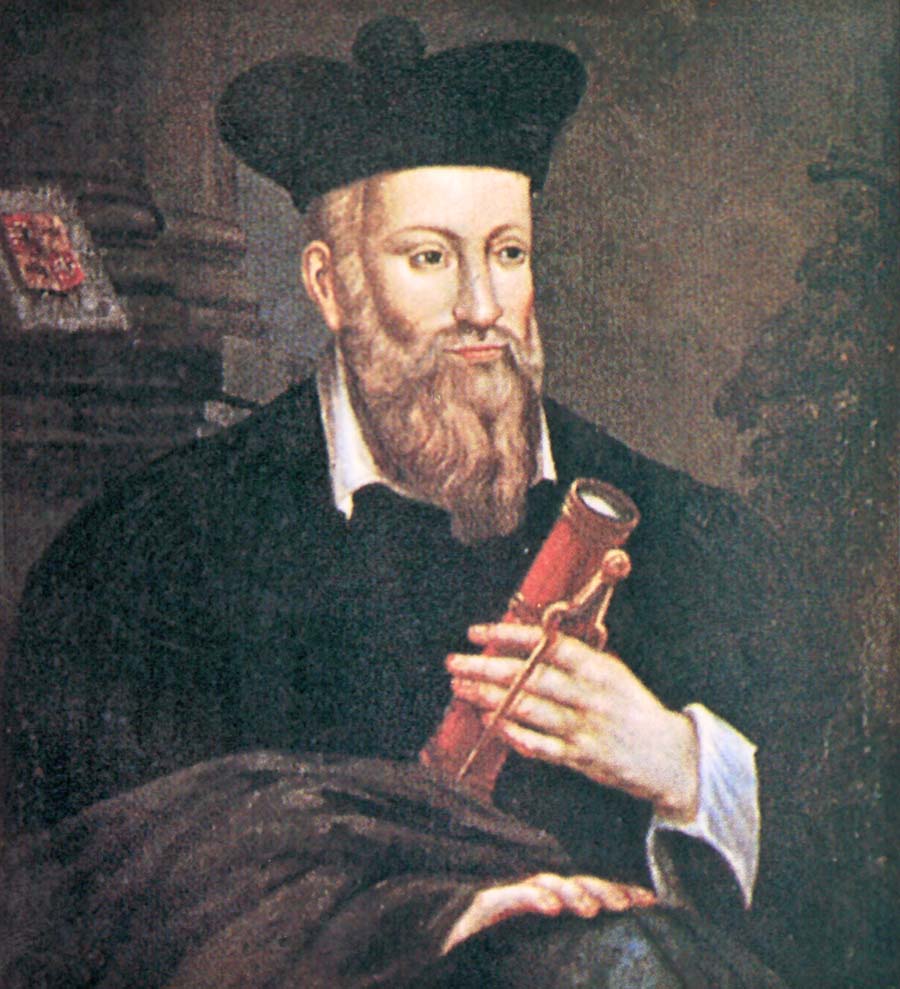
Before asking whether Nostradamus predicted 2017, ask where the prediction appears in his text. A modern list about cloud computing, solar power and national politics is not an authenticated prophecy simply because it carries his name.
Begin with an identifiable edition
The Bibliothèque nationale de France catalog documents a 1984 facsimile of Les Prophéties, Lyon 1555. That provides a bibliographic starting point. It does not establish that a particular modern claim is in the book or that a prophecy was fulfilled.
A source-based interpretation should identify its edition and passage, show the original wording and name the translation being used. If it refers to a quatrain, the four-line stanza must be identifiable. A modern heading cannot stand in for that evidence.
Text
What does the historical passage actually say?
Interpretation
What has a later writer added, inferred or translated?
Outcome
What event, date and scoring rule would test that interpretation?
Why modern technical language needs extra care
The old list included a claim about the disappearance of the term “cloud” from cloud computing. No historical passage was supplied. NIST published its cloud-computing definition in 2011, showing that the subject was already part of modern technical discussion before the list appeared.
This does not by itself trace where the old item originated. It does show why an attribution needs more than modern wording: which original phrase supposedly describes the technology, why is that reading justified, and how was the year 2017 derived? Without those steps, label it a modern, unverified attribution.
Four ways an interpretation can gain false precision
| Problem | What to check |
|---|---|
| A modern name appears only in the summary | Does the original passage identify that person, country or technology? |
| An exact year is added | Where does the date come from, and was that method fixed beforehand? |
| A vague phrase becomes a specific event | Which other readings were possible before the event occurred? |
| The deadline moves after a miss | Would the original wording still satisfy the new interpretation? |
Translation can matter too. Keep the original language alongside the translated version, and distinguish a literal translation from an explanatory paraphrase. A fluent sentence may conceal interpretive choices that make a prediction sound much more definite.
Do not turn uncertainty into an accuracy tally
The earlier list ranged from a specific geopolitical agreement to broad economic shifts and technological trends. Those items require different evidence. An identifiable treaty, a defined economic measure and a change in technical terminology cannot be scored merely by finding headlines that resemble them.
There is no useful percentage to calculate here without authenticated source statements and consistent outcome rules. An unresolved attribution is not a confirmed success. A partial resemblance is not necessarily fulfillment. Later events should not be moved into a claim’s fixed 2017 time window.
A reusable source-check worksheet
- Record the work, edition and exact passage identifier.
- Separate the original wording, translation and modern commentary.
- Find the earliest documented date of the proposed interpretation.
- Define the event and deadline before searching for matches.
- Compare official outcome records, including contrary evidence.
- Label the conclusion narrowly: supported, contradicted or unresolved.
You can study historical prophecy as literature or cultural history without accepting every viral list as authentic. Missing evidence is a reason for caution, not proof of a writer’s intentions.
Continue with checking the Baba Vanga inauguration claim, reviewing 2017 policy predictions and planning without promised certainty.
Frequently asked questions
1. Did Nostradamus publish this ten-item 2017 list?
The old page did not identify a historical edition, passage or reliable textual source for its modern list. It should not be represented as his authenticated wording.
2. What historical work can readers start with?
Les Prophéties is a starting point. The French national library catalogs a 1984 facsimile of its Lyon 1555 edition; a catalog entry documents an edition, not predictive accuracy.
3. What is a quatrain?
A quatrain is a stanza of four lines. A claimed interpretation should identify the exact stanza and edition rather than merely naming Nostradamus.
4. What should a prediction attribution include?
It should include the work, edition, passage identifier, original wording, translation details and an explanation of how the proposed event follows from the text.
5. Does a modern paraphrase count as an original quote?
No. Keep the source wording separate from a modern writer’s summary or interpretation.
6. Why is the cloud-computing item a warning sign?
It uses modern technical vocabulary without showing the historical passage or the interpretive steps. NIST’s definition of cloud computing was published in 2011; its existence does not authenticate a Nostradamus prediction.
7. Could an old text be interpreted as describing technology?
Someone can propose that reading, but it must be labeled an interpretation. Similarity alone does not establish that the author specified the technology or its date.
8. Does a familiar modern trend prove foresight?
No. A trend already discussed before a forecast can shape a modern prediction list without any supernatural information.
9. How should a geopolitical forecast be checked?
Identify the proposed event and deadline, then compare them with dated official records. Do not replace a specific peace agreement or merger with a vaguely similar development.
10. Can a vague phrase have several possible matches?
Yes. Record those alternatives instead of presenting one later-selected match as the only possible meaning.
11. Should a later event count toward a 2017 prediction?
Not if the claim specifically required it in 2017. Keep the original time window rather than extending it after the fact.
12. Can a library catalog prove a prophecy came true?
No. It can establish bibliographic facts about an edition. Testing a claimed event requires a separate evidential argument.
13. Does this article score all ten old claims?
No. It identifies missing attribution and scoring information; it does not invent a complete historical accuracy tally.
14. Is an unsupported attribution necessarily deliberate fraud?
Not necessarily. It may result from repetition, misunderstanding or poor sourcing. Lack of evidence does not establish a writer’s intent.
15. What is the most useful first check?
Ask for the exact historical passage and edition. If those cannot be supplied, label the modern claim unverified rather than passing it on as an original prophecy.
“Italy as the epicenter of financial crisis?” What a plot twist! It seems like Nostradamus had his finger on the pulse of economic calamities long before it became trendy to complain about them!
“The US will oppose Russia and Ukraine’s peace agreement?” This statement alone deserves scrutiny. The complexities of international relations cannot be distilled into simplistic predictions. A more nuanced discussion is warranted here.
Nostradamus’s interpretations are often too vague to be considered accurate. However, if we examine the socio-economic conditions in China and Latin America today, there may be merit in discussing their future trajectories.
While I appreciate the historical context provided, it is utterly absurd to rely on predictions from a 16th-century astrologer for understanding modern geopolitics. Nostradamus was not a prophet; he was merely an opportunist.
“Wars over global warming?” While dystopian narratives abound, one must ask: are we really prepared to confront such realities? It’s high time we stop romanticizing these predictions and instead focus on actionable solutions.
“Cloud computing will disappear by 2017” – sure! Next, they’ll say that flying cars are just around the corner! Nostradamus might as well have predicted unicorns for all the good this does!
“North Korea and South Korea will merge?” Sounds like something out of a political thriller rather than a genuine forecast. If only reality could align so neatly with our fantasies.
This article presents a fascinating perspective on Nostradamus’s predictions. The notion of a Russia-Ukraine peace agreement is especially intriguing, given the current geopolitical climate.