


The Chinese zodiac is familiar as a repeating cycle of twelve animals associated with years. It is a cultural and astrological framework, not a verified test of personality, trustworthiness or future success. Start with the animal order and the calendar convention before reading a horoscope.
You can appreciate its images and stories without assuming everyone born in the same year behaves alike. A birth-year label should not decide whom you date, hire or trust.
The twelve animals in order
Smithsonian cultural resources present the cycle beginning with Rat and ending with Pig. English sources may translate the eighth animal as Goat or Sheep. The Smithsonian American Art Museum’s Lunar New Year resource uses Sheep.
1. Rat
Next: Ox.
2. Ox
Next: Tiger.
3. Tiger
Next: Rabbit.
4. Rabbit
Next: Dragon.
5. Dragon
Next: Snake.
6. Snake
Next: Horse.
7. Horse
Next: Goat / Sheep.
8. Goat / Sheep
Next: Monkey.
9. Monkey
Next: Rooster.
10. Rooster
Next: Dog.
11. Dog
Next: Pig.
12. Pig
The cycle returns to Rat.
This order is a reference, not a ranking. Rat is not “better” than Ox, and Pig does not determine wealth. Animal descriptions in popular horoscopes are symbolic character sketches rather than evidence about a particular person.
Check the calendar boundary
Do not assume that January 1 begins a new animal year in the traditional calendar. If your birthday falls near the relevant new-year boundary, a Gregorian-year-only list may give a misleading answer.
The Hong Kong Observatory’s calendar resources provide Gregorian–lunar conversion tables. Use the table for the actual year you need rather than taking a current-year example as a birth-date lookup.
1. Identify the date
Use the full date privately; you do not need to post it publicly.
2. Check the boundary
Consult the relevant calendar table and the source’s stated convention.
3. Keep the label in context
An animal-year result is not a personal diagnosis or prediction.
Detailed astrological methods can use more information than a year label. If two practitioners disagree, ask which calendar boundary and method they use. A simple animal list should not pretend to be a complete chart.
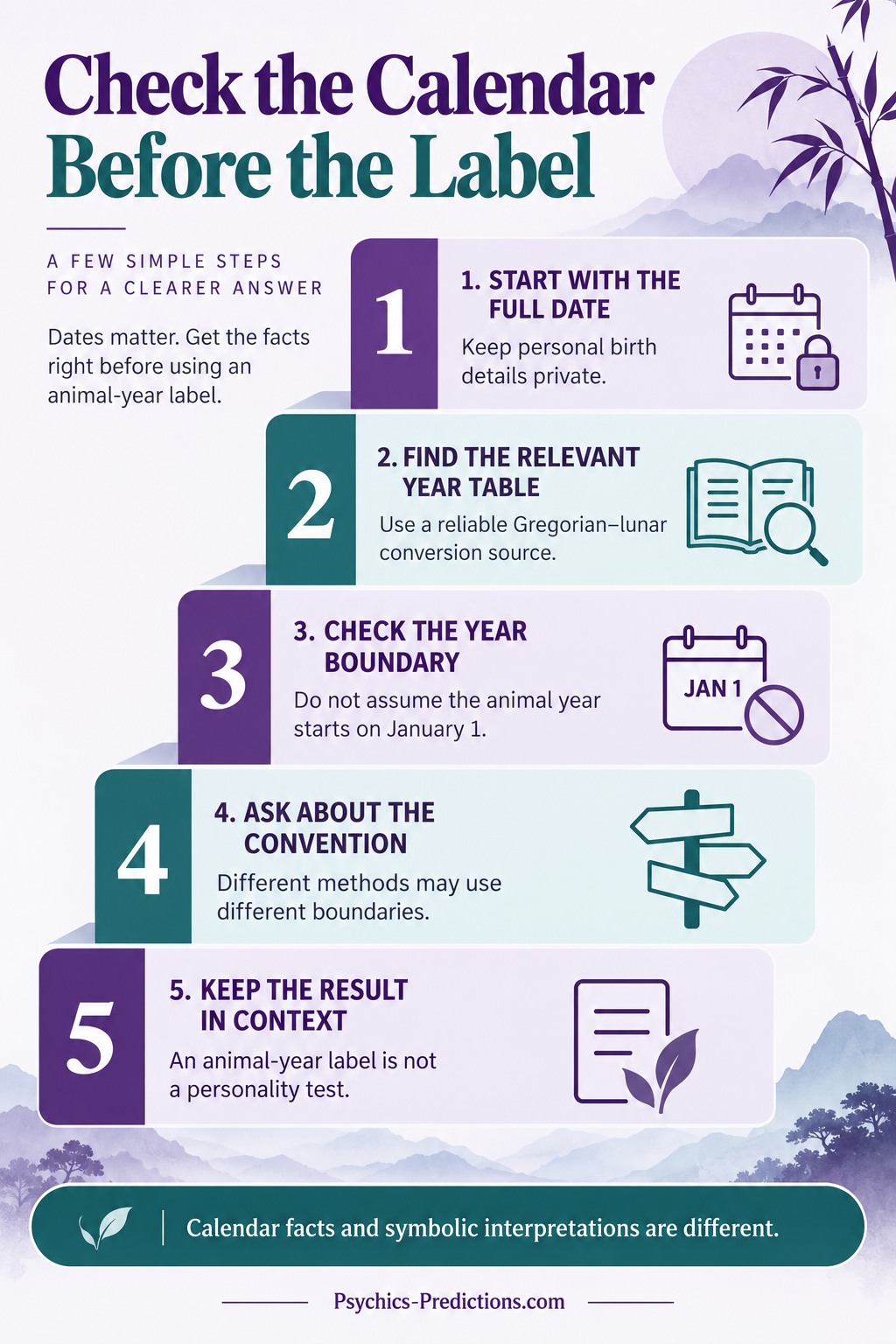
Read the infographic as text
- START WITH THE FULL DATE
Keep personal birth details private.
- FIND THE RELEVANT YEAR TABLE
Use a reliable Gregorian–lunar conversion source.
- CHECK THE YEAR BOUNDARY
Do not assume the animal year starts on January 1.
- ASK ABOUT THE CONVENTION
Different methods may use different boundaries.
- KEEP THE RESULT IN CONTEXT
An animal-year label is not a personality test.
Calendar facts and symbolic interpretations are different.
The five elements are part of a symbolic framework
Wood, Fire, Earth, Metal and Water appear in traditional Chinese astrological descriptions. These terms are not the same as a laboratory measurement of your body or a medical explanation for symptoms.
It is also misleading to translate an animal year directly into a Western sun sign. The familiar Chinese year cycle and Western zodiac use different frameworks. Learning the distinctions is more useful than forcing a one-to-one match.
Replace stereotypes with questions about actual life
| A claim you may encounter | A more useful question |
|---|---|
| “This animal is always loyal.” | Does this person keep their agreements and respect boundaries? |
| “This year makes people wealthy.” | What resources, costs and risks actually affect the decision? |
| “These animals cannot be compatible.” | Can the people communicate and agree on the relationship they want? |
| “Your animal determines your career.” | What skills, interests and practical opportunities fit you? |
For relationship reflection, our guide to useful love questions focuses on choices and communication rather than hidden intentions. A symbolic description should not replace that conversation.
Learn from cultural sources without flattening differences
Stories, translations and practices can vary. Name the source or tradition when presenting a particular interpretation; do not imply that one commercial horoscope represents an entire culture.
Enjoy symbolism, check calendar facts and ground consequential decisions in actual information. For related topics, explore zodiac symbolism and practical skills or our historical numerology guide.
Frequently asked questions
1. What is the Chinese zodiac?
It is a traditional twelve-animal cycle used to label years. Cultural symbolism and astrological interpretations should not be confused with verified personality tests.
2. What is the order of the animals?
Rat, Ox, Tiger, Rabbit, Dragon, Snake, Horse, Goat, Monkey, Rooster, Dog and Pig.
3. Is the eighth animal a goat or a sheep?
English-language sources use both names. A different translation does not necessarily mean a different place in the cycle.
4. Can I find my animal from a Gregorian birth year alone?
A rough year list can be misleading near a change of year. Check the relevant calendar boundary and the convention used by the source.
5. Why do January and February birthdays need care?
The traditional calendar’s year boundary is not simply January 1. Check the actual date instead of assuming the whole Gregorian year has one animal.
6. Do the animals determine personality?
Do not treat the label as a factual assessment of an individual. People sharing a year can have very different lives, values and behavior.
7. Does the zodiac prove compatibility?
No. Shared interests, communication, consent and actual behavior matter more than a symbolic pairing.
8. What are the five elements?
Wood, Fire, Earth, Metal and Water are labels used within the traditional framework. They should not be read as a medical account of your body.
9. Is this the same as a Western sun sign?
No. The familiar animal-year cycle and Western sun-sign labels use different frameworks. They are not direct translations of each other.
10. Can I use my animal as a spirit guide?
That is an additional personal interpretation, not something established by identifying a birth-year label. Avoid assuming it represents every Chinese tradition.
11. Does an animal year guarantee luck or wealth?
No. A symbolic label does not guarantee financial or relationship outcomes.
12. Should I pay for a reading to identify the animal?
You do not need a paid reading to consult a calendar reference. Check the date and method used.
13. Can I share my child’s zodiac animal?
Consider privacy before sharing a full birth date or other identifying information. A public chart does not require publishing personal details.
14. Why do different charts disagree?
Check translation, calendar boundary and the method used before assuming a chart is correct. Ask the source to explain its convention.
15. How can I learn respectfully?
Use cultural and calendar sources, acknowledge variation and avoid treating a community’s traditions as a collection of personality stereotypes.
One wonders if the wise sages of old ever considered how astrology would be interpreted through social media filters today—what an amusing thought!
The connection between the elements and personality traits in Chinese astrology is a fascinating intersection of culture and philosophy. It’s intriguing how these ancient practices still resonate today.
‘The Pig means wealth?’ Sounds like my last New Year’s resolution! Maybe if I channel my inner pig, I’ll finally achieve that financial freedom!
This article beautifully illuminates the depth and complexity of Chinese astrology. The comparison with Western systems is particularly insightful, showcasing how both have their unique value. Bravo!
While I appreciate the effort in elucidating Chinese astrology, I find it hard to accept such superstitions as having any basis in reality. Astrology, in any form, lacks empirical evidence.
‘Animal signs as life guides’? This sounds more like an ancient marketing strategy than genuine spiritual insight. But hey, whatever floats your cosmic boat!
‘Wealth’ is subjective. For some, it’s about money; for others, it’s just having enough snacks to last the week.
‘Five elements of balance’—a refreshing perspective! In a world so chaotic, this reminder to seek harmony is a valuable takeaway for all.
But can we really draw reliable conclusions from this system? Philosophically speaking, isn’t it just a reflection of our own biases?
‘Generosity’ and ‘wealth’? So pigs are basically philanthropists with a bank account? I’m sold!
‘The Rat is sociable?’ Really? If only they could teach us all how to charm our way through life while dodging metaphorical cat traps!