
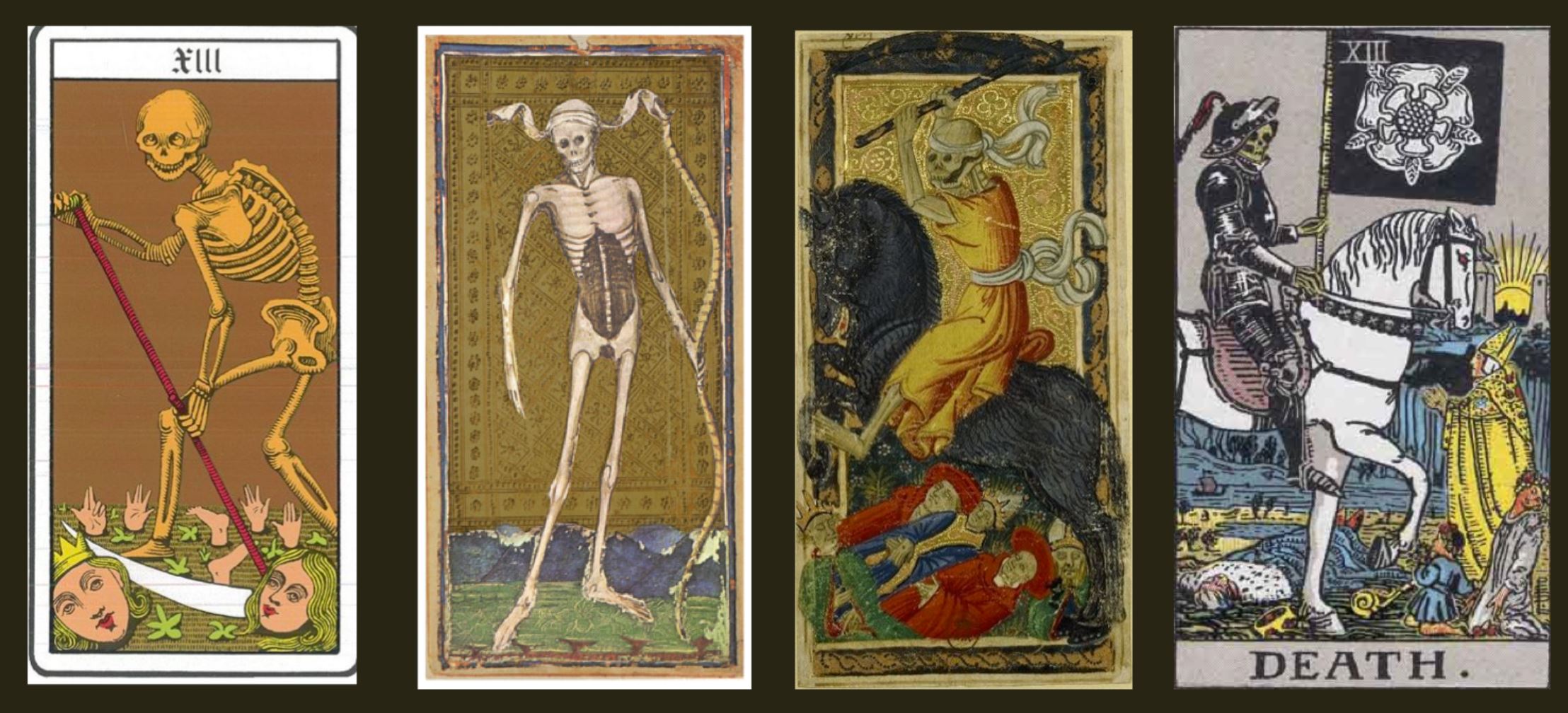
A tarot card is not evidence that you or someone close to you will die. Neither the Death card nor a combination of cards should be used to diagnose illness, predict an accident or decide a person’s lifespan.
The imagery can feel unsettling, especially during grief or a period of health anxiety. You can take that feeling seriously without accepting a reader’s interpretation as a fact. You are allowed to stop the reading, decline that topic or put the cards away.
What the Death card can mean—and what it cannot establish
In many contemporary reading practices, Death is used as a symbol of an ending, transition or release. That is an interpretive convention, not a test of what will happen. Decks and readers differ, and you do not have to accept an interpretation that does not fit your experience.
A useful reflection might be, “What change am I already dealing with?” or “What do I need to acknowledge before deciding my next step?” An unhelpful leap is, “This picture proves a specific person will die.” The card supplies an image; it does not supply independently checked evidence about a person’s health.
Tarot’s history also needs care. The Morgan Library’s account of Renaissance tarot describes cards used for a game, not primarily fortune-telling. The existence or age of a tradition does not demonstrate predictive reliability.
Three dramatic cards, three separate questions
| Card | Possible reflective theme | Unsupported conclusion |
|---|---|---|
| Death | An ending or change you can name in your current life. | A person will die or a lifespan is known. |
| The Tower | Disruption, an assumption being challenged or an unexpected change. | A particular accident or disaster has been established. |
| Ten of Swords | A painful ending, exhaustion or a story you feel has reached its limit. | A diagnosis, injury or death is medically indicated. |
These are examples of symbolic readings, not fixed meanings. Drawing two cards together does not turn those interpretations into a validated forecast. A reversed card cannot establish that a hazard has been prevented.
If a reading frightens you: a short reset
1. Stop the interpretation
Put the cards aside or end the session. You do not need another spread to earn permission to pause.
2. Name the concern
Separate what was said from what you independently know. Is there a symptom, a practical risk or only the reader’s claim?
3. Choose appropriate help
Use actual safety information and qualified support. Keep payment and refund questions separate from urgent care.
A sentence you can use is: “I don’t want predictions about death or health. Please stop this topic. I am ending the reading.” If the reader pressures you to continue, you do not have to debate the cards before leaving.
For optional stress support, the NHS describes gentle breathing without forcing the breath. A brief pause is not treatment and should not delay help for symptoms. If fear continues or interferes with daily life, seek qualified support; the NHS anxiety guidance explains when to speak with a healthcare professional.
You are not responsible for “attracting” a tragedy
Do not accept the claim that thinking about death, drawing a card or asking a difficult question made an illness or loss happen. Fear is an experience, not proof of supernatural causation. People facing grief deserve care, not blame for their thoughts or a demand to become more positive.
You can also decline claims that a missed prediction was your fault because you doubted the reader. That explanation does not provide evidence for the original claim. Our prediction-assessment guide explains why the original wording and complete record matter.
Do not use a spread to decide treatment, travel or safety
For health questions, contact an appropriately qualified professional. Do not change prescribed treatment because a reader predicts illness or promises protection. For a trip, review current official advisories, transport conditions and your own circumstances rather than a card combination.
A fictional example: a reader tells Maya that the Tower means she should cancel a flight. Maya does not treat the claim as an airline safety report. She checks relevant travel information and any actual personal concerns. Whether she ultimately travels or not cannot, by itself, establish that the reading prevented a crash.
For other consequential decisions, use the guide to deciding whether to act on a prediction. A frightening statement does not become more reliable because it feels urgent.
Paid protection and repeated reassurance
Be cautious if someone connects a death claim to an immediate purchase: another session, curse removal, special materials or guaranteed protection. Pause, save relevant messages and review the provider’s complaint and payment options. Do not share additional sensitive information to prove that you deserve help.
Repeatedly drawing cards to find a comforting result can also keep the concern active. Consider a break from the topic and talk with someone you trust. You do not need a final “good” card to stop.
A gentler way to use the imagery
If you still want to work with the card, keep the exercise voluntary and grounded in the present. Write three lines: what is changing, what is within your control and one small action you can take. Leave questions about another person’s lifespan out of the exercise.
You do not have to describe a bereavement as a blessing or a lesson. Sometimes the most useful response is to acknowledge loss, make room for support and avoid further predictions.
Frequently asked questions
1. Can tarot reliably predict a death?
Tarot should not be treated as a reliable way to determine whether, when or how someone will die. A card interpretation is not a medical assessment or verified forecast.
2. Does drawing the Death card mean someone will die?
No. The card’s name and imagery do not establish a person’s future. Many readers use it symbolically to discuss endings or change.
3. What if Death appears with the Tower?
A combination can prompt an interpretation, but it does not establish an accident, illness or death. Ask the reader to keep symbolism separate from factual claims.
4. Can the Ten of Swords diagnose a health problem?
No. A card cannot diagnose a medical condition. Bring symptoms or health questions to an appropriately qualified healthcare professional.
5. Can a reversed card guarantee that danger is avoided?
No. Reversal meanings vary by reader and do not establish that a real-world hazard has appeared or disappeared.
6. Can worrying about a card attract death?
A frightening thought is not evidence that you caused or attracted an event. Do not accept blame for illness or loss based on a reading.
7. Should I cancel a trip because of a tarot prediction?
Check actual travel advisories, conditions and personal circumstances rather than a card interpretation. Real safety information should guide the decision.
8. Should I buy another reading to check the first one?
You can pause instead. Repeated readings can leave the original question unresolved while increasing spending and worry.
9. What can I say to stop a frightening reading?
You can say that you do not want death or health predictions and that you are ending the session. Discuss any refund separately under the provider’s terms.
10. Can I use the Death card for reflection?
Yes, if you want to. You might ask what has ended, what needs acknowledging or what practical change you can choose. You do not need to force a positive lesson.
11. Does a prediction coming true once prove tarot accuracy?
No. Assess the original wording, timing, available information and the full record of claims, including misses and unresolved statements.
12. What if a reader says I need paid protection?
Treat urgent payment demands tied to curses, death or guaranteed protection as a reason to stop and reassess. Do not pay under pressure.
13. What if I am grieving?
You can decline readings about the person who died or seek appropriate grief support. A reading cannot certify the cause of a death or establish communication with the deceased.
14. When should I seek help for anxiety after a reading?
If worry persists, affects sleep or daily activities, or feels difficult to manage, contact a qualified healthcare or mental-health professional rather than relying on more readings.
15. What if there is immediate danger?
Use local emergency services for immediate danger or urgent medical needs. In the United States, call or text 988 for suicide crisis support. Elsewhere, use a verified local crisis service.
The article rightly emphasizes that many interpretations exist for each card drawn during a reading. It’s crucial for readers to engage critically with these symbols.
‘The future is not set in stone’ resonates deeply with me! It’s comforting to know that our actions can influence what lies ahead, even in the realm of Tarot.
‘If you seek death, it stands to reason you will attract it.’ Is this a dating advice column or a Tarot guide? Hilarious!
The interplay of energy and intuition in Tarot readings is fascinating! I wonder how individual interpretations can alter perceived outcomes.
While I appreciate the attempt to demystify Tarot, the idea that cards can predict death feels like pure superstition to me. We should rely on science rather than metaphysical whims.
Your skepticism is understandable, but dismissing Tarot entirely overlooks its cultural significance and psychological impact. It’s not about prediction but reflection.
Why not just ask Google instead of consulting cards? ‘Dear Google, will I die today?’ Much simpler if you ask me!
‘Death predicted by cards’? Sounds like a thrilling plot twist for a horror movie! Perhaps we should consult the cards before watching anything scary.
‘Tarot predicts death’—what’s next? A crystal ball forecasting my grocery bill? The absurdity just keeps escalating!
@CynicalCynic, don’t give them ideas! Imagine an entire genre dedicated to predicting mundane events through ancient symbols!
This article provides an insightful analysis of Tarot’s complexities. The notion that the death card symbolizes transformation rather than a literal end is a refreshing perspective.
I agree with you, SkepticalSam! Tarot readings can sometimes lead to fear-mongering rather than providing clarity or guidance.