


Quick Guide
A prediction is not an instruction. Identify the action you are considering, check evidence outside the reading and ask whether the step still makes sense if the prediction is wrong. Never delay urgent care or override another person’s consent.
On this page
A psychic prediction may prompt reflection, but it should not be the only reason you make a big decision. The more an action affects your money, health, safety, or someone else, the more evidence and advice are needed.
You can believe in intuition and still take a chance to pause before you take action. A reading doesn’t take away your right to disagree, change your mind, or decide that an interpretation is too uncertain to use. Feeling strongly affected is one reason to give yourself room to think, not proof that the prediction has to be followed.
This guide gives you ways to evaluate a prediction without dismissing its personal meaning. The examples in this article are hypothetical and are meant to show you how you need to process your decisions before you take action.
Write Down What Was Said
Start with what they said and write down the exact statement as closely as you can remember it. Separate the reader’s words from your own explanation. If they said, “A change is coming around your work,” this is different from “I should resign this week.”
If you have an authorized transcript or recording, look at the relevant passage once. Notice if the reader talked about possibilities, made a definite claim, or offered you advice. These are different kinds of statements.
Record what information you’d already given them. A reader who knows you’re applying for a job might have context for discussing work changes. This doesn’t mean the conversation is meaningless, but it matters when you’re looking at how surprising you thought the statement was.
Predictions and Action
A prediction describes something that might happen, and an action is something you choose to do. The connection between them is often given by the client instead of just stated by the reader.
The reader might say, “You might reconnect with someone from your past,” and this doesn’t mean you should contact the person who asked you not to contact them. If they talk about a financial opportunity, it doesn’t mean that you should invest in the next offer you get.
You should ask yourself what action you’re considering and why. Then, figure out the reasons from facts and what came from the reading itself. This makes it easier to see if the action is supported by information outside the prediction.
You might find that the reading just brought your attention to a choice you already wanted to look at. If this is the case, look at the choice on its own instead of treating the prediction as giving you permission.
Give Yourself Time to Think
A reading can sometimes leave you feeling excited, scared, hopeful, or overwhelmed. When a decision doesn’t need to be made right away, give yourself some time before spending a lot of money, ending a relationship, quitting a job, or making another major change.
There isn’t one perfect amount of time that you have to wait. You might need a few hours, a night to sleep on it, a conversation with someone you trust, or enough time to look into the situation yourself. The important thing is giving yourself a chance to think after the strongest emotions have settled down.
Also, don’t automatically treat a deadline from a reader as a real deadline. If someone tells you that you have to do something before midnight or you’ll lose an opportunity, ask yourself why that deadline actually exists. Feeling pressured can make something seem urgent when there might not be any real reason that you have to act immediately.
Of course, actual emergencies are different. Don’t delay medical care, help with an immediate safety concern, or another urgent situation because you’re waiting to think about something that came up during a reading. Those situations should be handled with the appropriate professional help as soon as possible.
Think About What Could Happen If the Prediction Is Wrong
Before making a decision based on a reading, think about how serious the decision is and how difficult it would be to undo. Writing about a prediction in your journal or asking someone a respectful question is very different from borrowing money, leaving a job, or accusing someone of something serious.
One question you can ask yourself is, “Would this still make sense if the prediction turned out to be wrong?” For example, preparing for a job interview could still help you even if a prediction about getting the job doesn’t come true. Quitting your current job without looking at your finances or other options could have much bigger consequences.
This doesn’t guarantee that every decision will work out exactly how you want it to. It simply helps you pick actions that still have some value even if the spiritual prediction isn’t accurate.
The bigger the decision, the more important it is to use information outside of the reading too. Medical concerns should be discussed with an appropriate healthcare professional. Contracts and financial decisions should be carefully reviewed, and professional advice might be helpful when needed. Relationship decisions should also be based on things like the other person’s actual words, actions, boundaries, and consent instead of depending only on a prediction.
A Safer Decision Filter
Separate the exact prediction from the action you are considering. Artificial urgency is not evidence.
Look for independent facts, real costs, consent and qualified advice where the stakes require it.
Prefer a useful, reversible action with clear time and spending limits. You may also take no action.
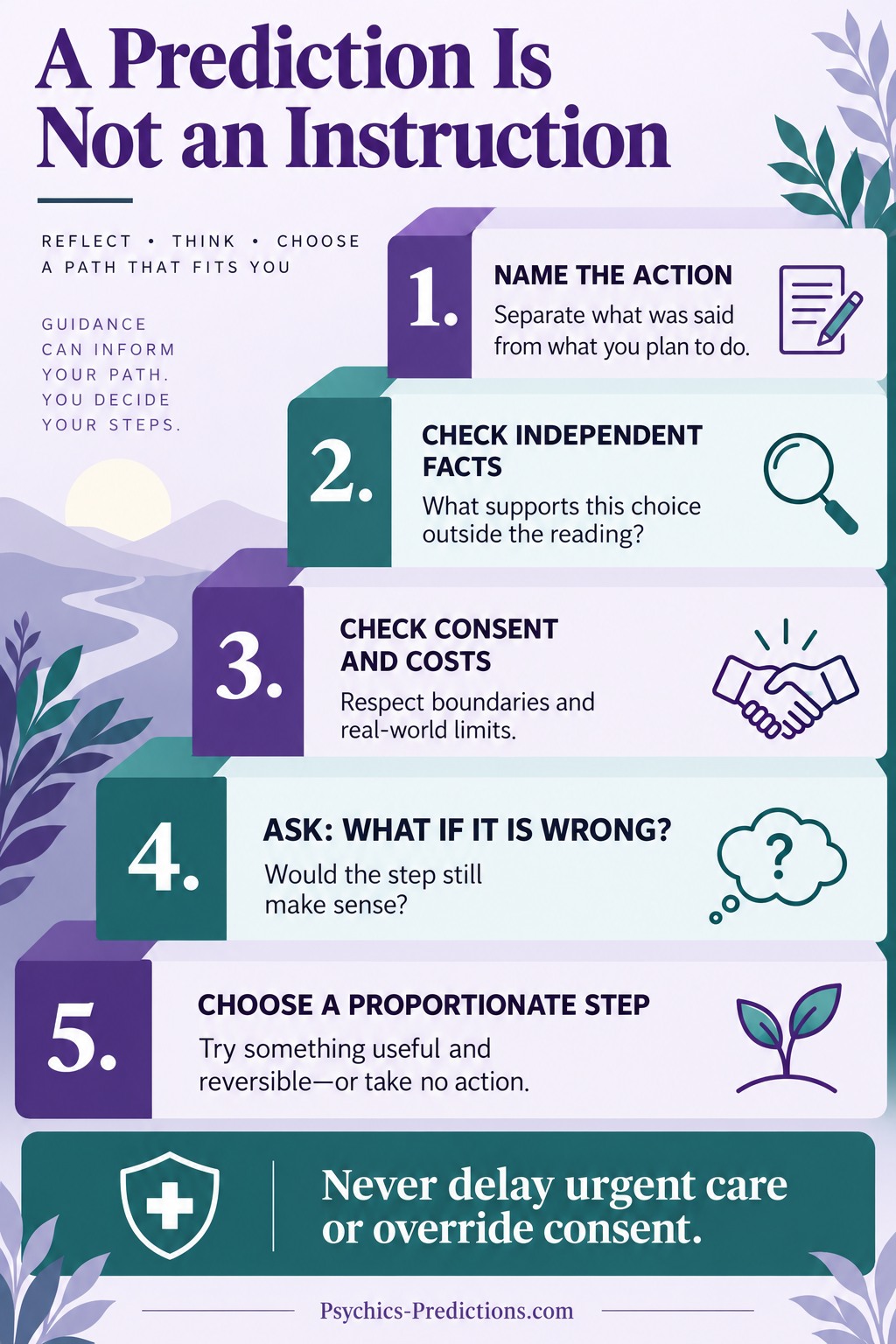
Read the infographic as text
- NAME THE ACTION
Separate what was said from what you plan to do.
- CHECK INDEPENDENT FACTS
What supports this choice outside the reading?
- CHECK CONSENT AND COSTS
Respect boundaries and real-world limits.
- ASK: WHAT IF IT IS WRONG?
Would the step still make sense?
- CHOOSE A PROPORTIONATE STEP
Try something useful and reversible—or take no action.
Never delay urgent care or override consent.
Relationship Predictions
A reader might predict things like marriage, reconciliation, separation, or a hidden attraction. These claims are about another person whose choices are their own. A reading can’t create consent on their behalf.
If someone declines contact with you, respect their boundaries. Don’t use a prediction as a reason to keep messaging, show up at their workplace, or ask other people to persuade them. You can reflect on your own hopes without acting against these wishes.
If a prediction says that someone’s cheating or betraying you, separate it from the evidence. You might decide to discuss a real concern respectfully, but spiritual claims alone aren’t a basis for accusing others.
For a breakup-specific example, read our guide to consent, contact and reconciliation.
Health Predictions and Treatment
Don’t use a reading to decide whether a symptom is harmless, whether a condition is there, or whether medication should be stopped or changed. A positive prediction doesn’t rule out an illness, and an alarming one doesn’t diagnose you.
NCCIH’s guidance on complementary health approaches advises against replacing or postponing conventional care with unproven practices. If a reading raises a health worry, take the actual symptoms or concerns to a qualified professional.
You can say that the conversation made you feel anxious about your health, and you’d like to understand what needs attention. A clinician can respond to your situation without treating the prediction as medical evidence.
If a reader tells you that the treatment is going to block your intuition or that the illness is punishment for disbelief, take a step back. You should be able to access care without accepting a spiritual explanation.
If a reading predicts a death, see how to respond without treating a death prediction as fact.
Be Careful with Predictions About Money
A prediction about getting rich, having good luck, or receiving a financial opportunity doesn’t automatically mean that an investment or business opportunity is safe. Before putting money into anything, look into the company or person involved, the possible risks, the fees, and exactly what you’re being promised.
Don’t borrow money or use money that you need for bills, food, housing, or other important expenses because a reader tells you that you’re guaranteed to make it back. No spiritual reading can guarantee that an investment will make money or tell you how much financial risk you can actually afford.
Also be careful if a reader predicts a financial problem or bad luck and then immediately offers to fix it for another fee. For example, someone might claim that you have negative energy affecting your finances and then tell you that you urgently need to pay for a cleansing. At that point, you’re being asked to spend money, so treat it like any other financial decision and think about it before paying.
The United States Postal Inspection Service has also warned consumers about psychic scams that can involve promises, threats, and repeated requests for money. The concern isn’t simply that someone believes in psychic abilities. What matters is how the person is behaving, what they’re promising, and how they’re asking you to spend your money.
Research Work and Education Decisions
A reading might give you an idea about changing careers, going back to school, or trying something completely different. You can use that inspiration as a reason to explore the possibility without treating the prediction like an instruction that you have to follow.
Start by looking into things like the education or training you would need, how much it would cost, how long it would take, and what the job is actually like. Talk with people who already work in the field if you can. You might also try something small first, such as taking an introductory class or talking with someone about their experience before making a big commitment.
For example, imagine that Priya has a reading and is told that teaching could be part of her future. Instead of immediately quitting her current job, she researches what she would need to become a teacher. She might also volunteer in an appropriate setting or talk with teachers about what their jobs are really like before deciding if the career fits her.
The reading might have introduced Priya to an idea that she hadn’t seriously considered before. However, her final decision would come from what she learns through research and experience instead of depending completely on the prediction. That gives her a much stronger way to decide if teaching actually fits her life and what she wants for her future.
Taking Small Action Steps
If a prediction feels interesting, ask if there’s an action that addresses an underlying concern. You might not need to choose between obedience and dismissal.
A prediction of conflict might prompt you to clarify an agreement. A prediction of change might remind you to update records or look at your priorities. These actions can be sensible without assuming that the predicted event is going to happen.
A general warning isn’t a reason to avoid every life situation or inspect every message. If the response is making daily life situations smaller, reconsider the role that the prediction is playing.
Taking smaller actions should improve your situation on its own. If its only purpose is to ward off an unverified supernatural threat, you might need to step back and talk to someone you trust.
If a Story is Never Wrong
Some predictions can be so flexible that any outcome can be a confirmation. If the event happens and the reader was right, but if it doesn’t, the explanation can be blocked energy, changed timelines, or your failure to believe.
This makes it hard to evaluate claims. Ask what outcome counts as a miss before you invest more money. A statement that can’t be checked shouldn’t be treated as strong evidence for action.
The Advertising Standards Authority discusses unsupported claims in its guidance for psychic and spiritual advertising. Its rules are specific to its jurisdiction, but asking what supports a promise is useful in any booking decision.
You aren’t being disloyal if you notice a failed prediction. An honest practice should leave room for uncertainty and for error.
Get Another Opinion Without Paying for Another Prediction
If you’re having a hard time deciding what to do after a reading, talk with someone who can help you think through the actual decision. This could be a trusted friend, therapist, financial professional, or someone who has experience with the situation that you’re dealing with.
Tell them what you’re thinking about doing and what information you have so far. You don’t have to convince them that the reading was spiritually accurate for the conversation to be helpful. Instead, you can talk about your options, what could happen with each one, and what matters most to you.
Booking more readings might seem like an easy way to get another opinion, but you could end up with completely different predictions. That can leave you even more confused and make you feel like you need to keep asking until someone gives you a definite answer.
If you do decide to talk with another spiritual reader, remember that two readers saying something similar doesn’t automatically prove that the prediction is true. Think about what information each person had and how specific their statements actually were. Sometimes similar readings can simply come from common spiritual ideas or interpretations.
Turn a Positive Prediction into Something You Can Actually Try
Positive predictions can be exciting, especially when they involve something that you’ve already dreamed about doing. Imagine that a reader tells you that a creative opportunity is going to completely change your career. If you’ve always wanted to write, hearing that could make you feel like it’s finally time to do something about it.
Instead of immediately making a huge change, think about something realistic that you could try first. You might set aside a little time each week to write or submit something to a publication after checking its guidelines and terms. Those things could still benefit you even if the opportunity from the prediction never happens.
Bigger decisions need more thought. Quitting your job or paying someone a large amount of money because they promise to connect you with an opportunity would involve much more risk. Before doing something like that, make sure that you have enough information to make the decision without depending only on the prediction.
It can also help to make a simple plan for yourself. Write down what you want to try, how much money or time you’re willing to put into it, what you hope to learn, and when you’ll decide if you want to continue. Give yourself a stopping point too, such as reaching a certain spending limit or finding out that an opportunity isn’t what you were originally promised.
You can still enjoy the encouragement that came from the reading while making the final decision for yourself. Being hopeful doesn’t mean that you have to ignore practical information. You can feel inspired while still checking the details, looking into the people involved, and deciding if an opportunity actually makes sense for your life.
Review What Happened
If you want to learn from a reading you had, keep the original wording and look at it later. Pay attention to clear matches, clear misses, and outcomes that are too vague to judge.
Don’t just count on the most memorable success and forget the rest. Avoid changing the time frame after an event unless you label this as a new interpretation.
You can write down whether the reading was useful to you personally. Maybe it gave you a good conversation, even if the prediction didn’t happen. This is a different kind of value and can be acknowledged honestly.
This approach supports a spiritual practice that can learn from experience, and it doesn’t require turning every outcome into proof or viewing uncertainty as a failure.
Final Thoughts: Predictions and Fear
If you are always looking for signs, losing sleep, or feeling unable to make good decisions, then put readings on hold. Go back to paying attention to what you know and what you can do in the present.
You might need to mute follow-up messages or decline contact from a reader who keeps renewing the fear. Setting a boundary, such as “I’m not purchasing further services. Please stop contacting me,” can work, but keep records if the messages include threats or disputed charges.
If you keep having anxiety or this interferes with your daily life, get qualified mental health support. You can ask for help to manage the impact of this without abandoning your spiritual beliefs.
A prediction should never own your future. Let this be something you consider, question, or set aside. Actions need reasons that can withstand uncertainty, especially if the consequences matter to your finances, safety, health, or relationships.
For a more systematic record, use our prediction scoring methodology. If accounts conflict, read why two psychics can give different predictions before paying for further reassurance.
Key Takeaways
- The greater the consequences, the stronger the independent support needed.
- A prediction cannot diagnose illness, guarantee returns or create another person’s consent.
- Record misses and vague outcomes as well as apparent matches.
- If readings are disrupting sleep or daily life, pause and seek appropriate support.
Frequently Asked Questions
1. Should I follow a psychic prediction immediately?
Not simply because it feels powerful. If no genuine emergency requires action, give yourself time to check the facts and consequences.
2. What is the difference between a prediction and advice?
A prediction describes a possible event; advice proposes an action. Write each separately so you can see whether the proposed action has independent support.
3. What should I record after a reading?
Record the wording, date, time frame and information you had already supplied. Distinguish the reader’s claim from your later interpretation.
4. How long should I wait?
There is no universal waiting period. Take enough time to settle strong emotions and check the situation, without delaying urgent medical or safety assistance.
5. What if the reader gives a deadline?
Ask what external fact creates that deadline. A spiritual claim of urgency is not by itself a reason to spend or commit.
6. Can a prediction justify contacting an ex?
It cannot override a refusal or request for no contact. Respect the person’s actual words and boundaries.
7. Should I accuse someone based on a reading?
No. A psychic claim is not evidence that another person did something. Address real concerns without treating the interpretation as proof.
8. Can a reading guide medication changes?
Do not start, stop or change prescribed treatment because of a reading. Discuss health concerns with a qualified healthcare professional.
9. Can a prediction make an investment safe?
No. Examine ordinary risks, fees, terms and the provider independently. Do not use money needed for essentials because someone promises a return.
10. What is a lower-risk response to a career prediction?
Research qualifications, costs and working conditions, or try a modest exploratory step. Those actions can be useful even if the prediction is wrong.
11. Does agreement between two readers prove accuracy?
No. Similar accounts can reflect shared information or common interpretations. Agreement alone does not establish a prediction.
12. How do I evaluate a prediction that never seems wrong?
Ask in advance what would count as a miss. Explanations that change after every outcome make a claim difficult to test.
13. What if the prediction frightens me?
Return to verifiable facts and pause repeated checking. Talk with someone you trust; seek qualified support if anxiety persists or disrupts daily life.
14. Can I enjoy an encouraging prediction without believing it?
Yes. You can use it as an optional prompt for a worthwhile activity while making decisions on practical grounds.
15. How should I review the outcome?
Compare events with the original wording and deadline. Record matches, misses and outcomes too vague to judge, without rewriting the claim after the fact.