


Conflicting predictions do not prove that readers accessed different timelines. They may reflect ambiguity, different assumptions, new information, changed choices, or ordinary error—and they are best used as scenarios, not verdicts.
Quick Guide
- Write each prediction exactly, including date, conditions, and confidence.
- Separate checkable claims from advice and symbolic language.
- Do not use quantum physics as proof of psychic timelines.
- Choose actions that remain useful across several plausible futures.
Record
Preserve exact wording before the outcome.
Compare
Find assumptions, dates, and contradictions.
Test
Define what would count as a hit or miss.
Act
Prefer reversible steps that work in several scenarios.
Why Readings Diverge
One reader predicts reconciliation. Another sees a clean break. A third says the timing is “blocked.” The disagreement can feel profound, especially when the decision matters. But conflicting predictions do not require a cosmic explanation. Readers may use different systems, ask different questions, emphasize different cues, interpret symbols differently, or simply be wrong.
Your circumstances can also change. A forecast based on today’s behavior may no longer fit after a conversation, job offer, diagnosis, or boundary. That does not make every prediction correct. A claim should not become unfalsifiable merely by saying you “shifted timelines” whenever the result fails.
Parallel Timelines and Quantum Physics
Scientific uses of “many-worlds” concern the interpretation of quantum mechanics. Everett’s original relative-state paper examines quantum theory and observation; it is not a test of psychic readings. Inferring that a reader can inspect alternate personal futures would require separate evidence. Using the word quantum does not supply that evidence.
You may still use “timeline” as a metaphor for a possible path. Make that explicit: “If current conditions continue, this is one scenario.” Metaphor supports reflection; scientific language should not be used as borrowed proof.
Common Sources of Conflict
| Source | Example | Better question |
|---|---|---|
| Different assumptions | One reader assumes you stay; another assumes you leave. | What conditions does this forecast depend on? |
| Vague wording | “A return” could mean a call, visit, or reunion. | What exact event and deadline are being claimed? |
| Changed information | A new offer or conversation alters the decision. | Which facts changed after the session? |
| Interpretation or error | Readers assign different meanings to a symbol. | What alternative explanations fit? |
The site’s article on why people seek love predictions explains the emotional pull of certainty. Its review of famous prediction claims is best read with the source and scoring rules below.
Build a Prediction Ledger
- Record the exact question and what information the reader received.
- Copy the prediction without improving its wording.
- Add a date range, location, people, and observable outcome.
- Note confidence: possibility, likely, or certain.
- Define a miss before the deadline.
- Record advice separately from prediction.
- Review every claim, not only memorable hits.
A ledger prevents moving targets. If “soon” later becomes two years, or “contact” changes from a direct message to seeing a social post, the original claim did not become accurate—it was redefined.
Use our prediction log and evaluation guide to record claims consistently.
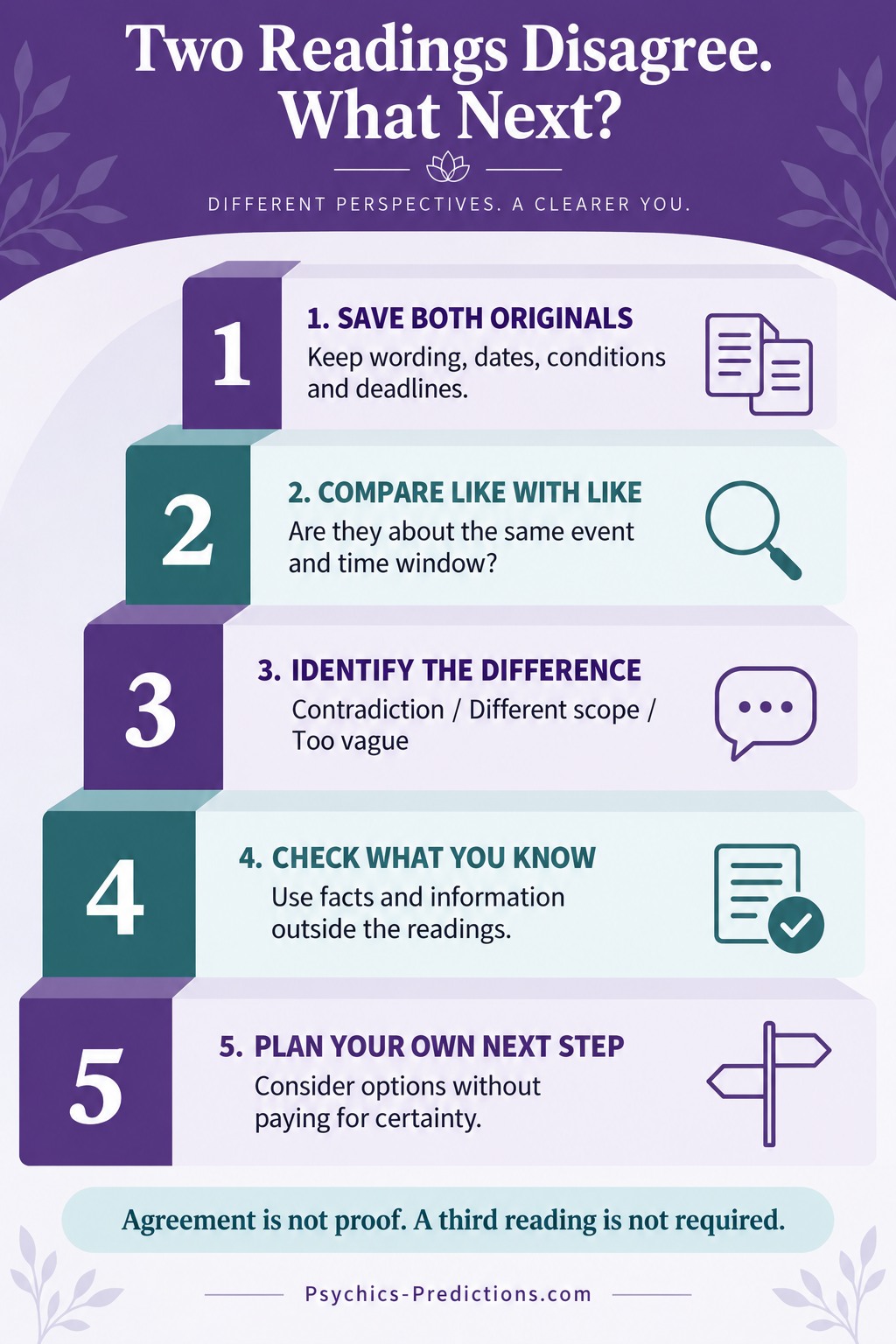
Read the infographic as text
- SAVE BOTH ORIGINALS
Keep wording, dates, conditions and deadlines.
- COMPARE LIKE WITH LIKE
Are they about the same event and time window?
- IDENTIFY THE DIFFERENCE
Contradiction / Different scope / Too vague
- CHECK WHAT YOU KNOW
Use facts and information outside the readings.
- PLAN YOUR OWN NEXT STEP
Consider options without paying for certainty.
Agreement is not proof. A third reading is not required.
Use Scenario Planning Instead of Certainty
Create three columns: desired outcome, plausible alternative, and adverse outcome. Under each, list signals you could observe and actions that preserve options. For a relationship, that might mean communicate once, respect a no, avoid surveillance, and maintain your own support. For work, verify the offer, protect cash flow, and avoid resigning solely on a forecast.
Before making a consequential choice, use the prediction safety guide.
What to Ask the Reader
Ask: “What part is observation, what part is interpretation, and what part is advice?” Ask what would change the forecast and whether the reader records misses. A responsible practitioner can say “I do not know.” Avoid anyone who charges repeatedly to stabilize a timeline, remove interference, or guarantee a preferred outcome.
The most useful reading leaves you with more agency, not a maze of invisible branches. When two predictions disagree, you do not need a third reader to break the tie. Return to evidence, values, and choices you can revise.
Key Takeaways
- Conflicting readings can arise from assumptions, ambiguity, changed facts, interpretation, and error.
- Many-worlds quantum theory does not validate psychic access to alternate personal futures.
- Exact, timestamped records make predictions testable and reduce hindsight editing.
- Scenario planning supports agency better than paying for certainty.
Frequently Asked Questions
1. Why do two psychics disagree?
They may use different methods, assumptions, cues, interpretations, or confidence levels, and either or both may be wrong.
2. Does disagreement mean I changed timelines?
Not necessarily. Changed circumstances are ordinary; a timeline shift is not required to explain a failed forecast.
3. What is the many-worlds interpretation?
It is an interpretation of quantum mechanics addressing measurement, not a validated method for personal psychic prediction.
4. Can quantum physics prove psychic readings?
Quantum terminology does not establish a reader’s predictive ability. A claim about readings requires its own evidence.
5. Can free will change a prediction?
Choices can change outcomes, but invoking free will after every miss can make a claim impossible to test.
6. How specific should a prediction be?
Record an observable event, timeframe, people or place, conditions, and what would count as a miss.
7. What is retrofitting?
It is reshaping vague wording after an event so the claim appears more accurate.
8. Should I get a third reading?
Usually not to break a tie; more readings can increase confusion and cost without adding reliable evidence.
9. What is scenario planning?
It is preparing for several plausible outcomes and choosing actions that remain useful across them.
10. Can a reading be useful if prediction is uncertain?
Yes, as a prompt for questions, values, and options—provided it is not treated as verified fact.
11. What if the reader says another psychic blocked the timeline?
Treat that as a red flag, especially if payment is requested to remove the block.
12. Should I follow a relationship prediction?
Communicate directly, respect consent, and judge behavior; never pursue or monitor someone because a reading promises reunion.
13. How do I score accuracy?
Use the original wording, predefined criteria, deadlines, and the full set of hits and misses.
14. Can predictions help financial decisions?
Do not use them as investment advice; rely on evidence, regulated professionals, and risk limits.
15. What is the healthiest response to conflicting readings?
Pause, document the claims, identify assumptions, and return to facts and reversible choices.