


If intuitive guidance matters to you, a fair prediction record can help you review what was actually said. Preserve the wording, define the outcome and deadline before events unfold, and keep the complete record—including misses and unresolved claims.
What belongs in the prediction record?
Save the original statement, source, publication date and a reliable pre-outcome record. Record any stated probability, conditions and deadline. Keep later edits separately instead of replacing the original.
Define the subject, event, location if relevant, time window and measurable threshold. “A career door will open” is too flexible for a meaningful binary accuracy score. “Alex will receive a written offer from Company A by 5 p.m. on October 31” can be evaluated if appropriate evidence is available.
Agree on ambiguous terms before seeing results. If “promotion” means a formal increase in rank, a lateral move should not later become a promotion merely because it makes the prediction look better.
The Center for Open Science’s preregistration guidance explains the value of specifying methods and analyses in advance. Applying that principle here reduces hindsight flexibility; it does not turn an informal prediction log into a controlled scientific experiment.
Keep outcome labels distinct
Hit
The defined event and every required condition occurred within the fixed window.
Miss
The resolution rule is satisfied for failure, including a deadline passing without the required event when its absence can be established.
Unresolved
The deadline is still open or adequate outcome evidence is unavailable. This is not a hit.
Not scoreable
The claim is too vague, non-factual or otherwise outside the prewritten eligibility rules. Record why.
Partial credit requires components and weights fixed in advance. Report it separately from strict hit counts. A claim that misses a required deadline remains a strict miss even if some descriptive details match.
Do not remove failures from the denominator
Define the sample before outcomes are selected: for example, all eligible predictions in a specified set of dated publications. A collection of favorable examples is a highlight reel, not a complete accuracy record.
Maintain an exclusion log for duplicates, non-predictions and unavailable evidence. “The event did not happen by the deadline” is not an exclusion reason when that is precisely the condition for a miss. Missing evidence and evidence of non-occurrence are different.
Report total collected claims, eligible claims, resolved hits and misses, unresolved claims and exclusions. A resolved hit rate should state its denominator and show how much of the original sample remains unresolved.
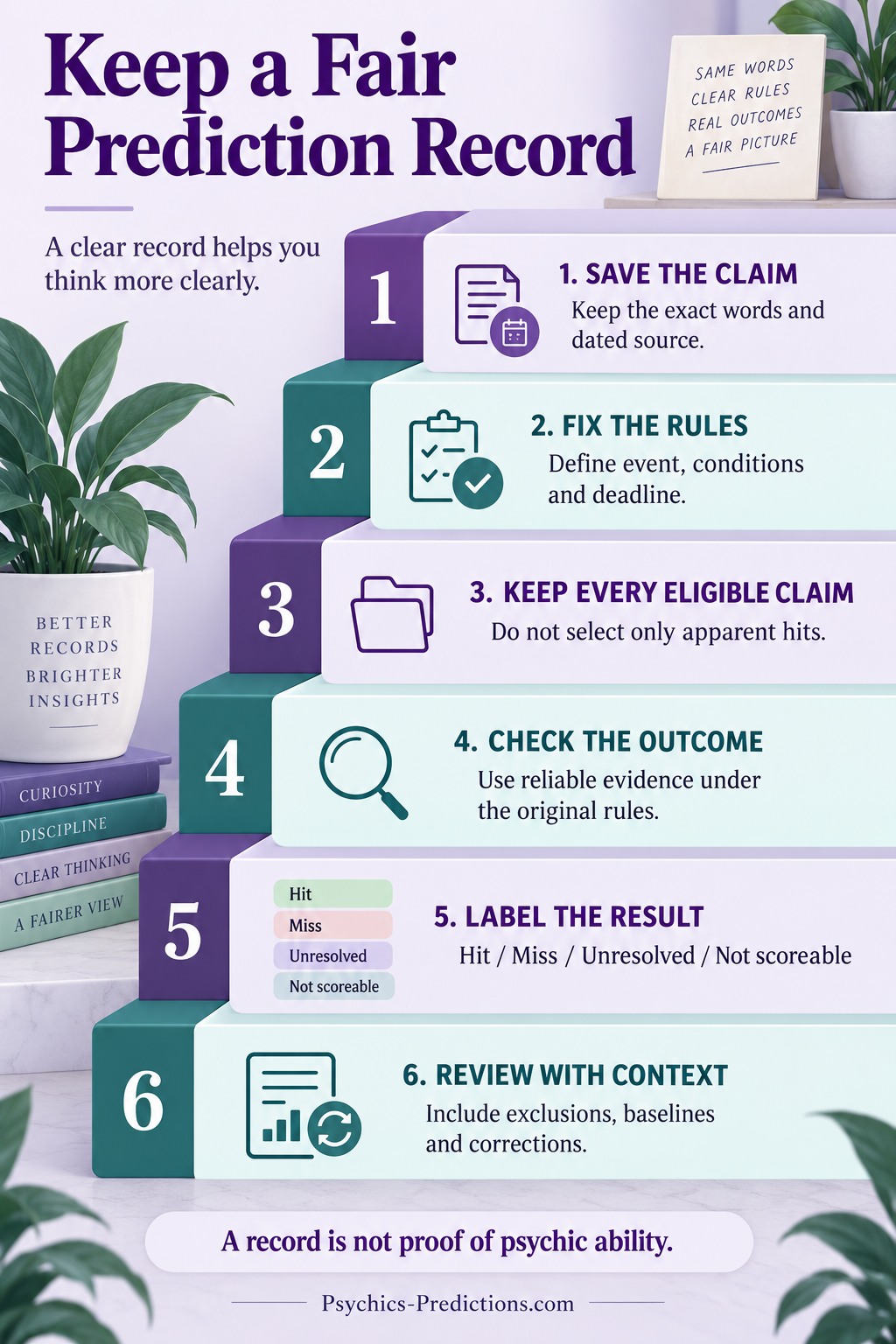
Read the infographic as text
- SAVE THE CLAIM
Keep the exact words and dated source.
- FIX THE RULES
Define event, conditions and deadline.
- KEEP EVERY ELIGIBLE CLAIM
Do not select only apparent hits.
- CHECK THE OUTCOME
Use reliable evidence under the original rules.
- LABEL THE RESULT
Hit / Miss / Unresolved / Not scoreable
- REVIEW WITH CONTEXT
Include exclusions, baselines and corrections.
A record is not proof of psychic ability.
A reusable prediction log
Copy these fields into your own notes. Record private information only where appropriate, and do not publish another person’s sensitive details.
| Before the outcome | After the deadline |
|---|---|
| Original wording and dated source | Outcome evidence and its source |
| Event, required conditions and deadline | Hit, miss, unresolved or not scoreable, with reason |
| Probability, only if originally stated | Calculation under the original rule, if applicable |
| Eligibility rule and intended sample | Exclusions, missing evidence and corrections |
How the Brier score handles probabilities
For a binary event, let p be the stated probability between 0 and 1, and y be 1 if the event occurs or 0 if it does not. The Brier score is the average of (p − y)² across resolved forecasts. Lower is better. Do not invent a numerical probability when the original forecast did not provide one.
In a fictional example, a 70% offer forecast followed by no qualifying offer has an error of (0.70 − 0)² = 0.49. A 40% relocation forecast followed by no relocation has an error of 0.16. Averaging those two gives 0.325. That number is not a “32.5% accuracy rate.”
ECMWF’s probability verification guide describes squared-error scoring and reference forecasts. Borrowing a measurement tool from weather forecasting does not establish that psychic forecasts share its evidence base.
Compare against a suitable baseline
An event that commonly occurs can be easy to predict. A high hit rate therefore needs context. The comparison should use the same events, time horizon and information available when the forecast was made.
Where a credible baseline exists, compare the protocol’s score against it and explain its source. Do not invent a base rate for a private life event. If no suitable reference is available, state that limitation and avoid claiming demonstrated skill beyond chance.
Calibration is also different from a single hit: across a sufficiently large comparable set, events forecast near 70% should occur roughly 70% of the time. Small, selected or highly dependent samples cannot support strong conclusions.
Independent review and correction rules
A stronger implementation would have two reviewers apply the same prewritten rules independently, cite outcome evidence and record initial agreement. A declared process should resolve disagreements without automatically selecting the more favorable score.
Actual reports must identify whether independent review occurred. This protocol page does not claim that reviewers have already been appointed or that existing articles have been rescored.
If evidence changes, keep the original score visible in a dated correction log. Explain the new evidence and apply the original rule. Do not quietly broaden the prediction to preserve a success.
What a future report should disclose
- The collection period, eligibility rules and complete claim count.
- Original wording and timestamps where privacy allows.
- Resolution rules, outcome evidence and all status counts.
- Probability scores and baseline methods, if applicable.
- Missing data, dependence between claims, uncertainty and reviewer disagreements.
- Financial relationships, selection limits and dated corrections.
Protect private people. Do not publish identifying medical, legal or safety claims to create a scorecard. Predictions should not guide treatment, legal judgments or urgent safety decisions.
Before acting on a claim, use our prediction safety guide. For related context, see why two psychics may give different predictions and our guide to reading service reviews. Service satisfaction, personal meaning and predictive accuracy remain separate questions.
For a broader look at format, service and claim evaluation, see are online psychic readings accurate?
Key Takeaways
- Fix claims and rules before outcomes are known.
- Keep misses and unresolved claims visible.
- A Brier score is an error measure, not a percentage accuracy rating.
- Comparison baselines and sample limitations matter.
- This protocol is not a completed test or proof of paranormal ability.
Frequently Asked Questions
1. Does this page report a tested psychic accuracy rate?
No. It describes a proposed protocol, with fictional examples. A completed report would need an actual sample, evidence and reviewer disclosures.
2. What makes a prediction scoreable?
It needs sufficiently clear wording, a defined outcome and time window, a pre-outcome record and evidence that can resolve it under fixed rules.
3. Why save the exact wording?
It prevents later summaries from dropping conditions or changing meanings to fit an event.
4. Is a vague statement always a miss?
Not necessarily. It may be classified as not scoreable under prewritten rules, with the exclusion disclosed rather than treated as success.
5. What is an unresolved prediction?
Its deadline is still open or reliable outcome evidence is unavailable. It must not be counted as a hit.
6. Can a missed deadline be excluded?
Not merely because it failed. If timing is a required condition and failure can be established, it belongs in the miss count.
7. When is partial credit appropriate?
Only when components and weights were specified before outcomes. Keep partial-credit results distinct from strict hit rates.
8. What is the Brier score?
For binary forecasts it is the mean squared difference between stated probabilities and outcomes coded as 0 or 1. Lower values indicate less probability error.
9. Is a Brier score a percentage accuracy?
No. A score of 0.325 does not mean 32.5% accuracy. It is an average error measure.
10. Can reviewers assign a probability afterward?
They should not invent one for probability scoring. Use the probability stated before the event or keep the claim outside that analysis.
11. Why compare with a baseline?
Common events can produce high hit rates without special skill. A comparable reference helps assess whether forecasts add information.
12. What if no credible base rate exists?
Disclose the limitation. Do not manufacture a comparison or claim demonstrated performance beyond chance.
13. Why use independent reviewers?
Independent application of fixed rules can expose judgment differences. Reports must say whether it actually happened and how disagreements were handled.
14. Can a correct prediction prove psychic ability?
A match alone cannot establish its cause. Selection, chance, prior information and other explanations require consideration.
15. Can a prediction be useful but wrong?
Yes. It might prompt helpful preparation without accurately forecasting an outcome. Usefulness and accuracy should be reported separately.