


A daily tarot pull can be a small learning or reflection ritual. It does not need to forecast your day. The most useful version leaves you with a question you can consider—not an instruction you must obey.
You do not have to draw daily, buy a special deck or perform a cleansing ritual to study the cards. Choose a pace that remains enjoyable and easy to stop. Missing a session is not a sign of failure or bad luck.
Choose the purpose before you draw
There are two straightforward reasons to try a one-card practice: learning the deck and using an image as a writing prompt. Keep them separate from factual prediction. Knowing a card’s conventional meaning does not establish that it can reveal tomorrow’s events.
The V&A’s history of tarot describes the standard 78-card structure and tarot’s earlier use as a game, before its later association with fortune-telling. The cards also have an artistic history worth exploring in its own right.
A simple routine: draw, describe, reflect, review
1. Draw and describe
Choose one card. Note the figures, objects, colors and movement you can actually see.
2. Reflect without forecasting
Read the guidebook if needed. Turn a symbolic theme into a question about your own choices.
3. Review your response
Later, note whether the question was useful. Do not force the day’s events to fit the picture.
For example, a card showing someone carrying a heavy load might prompt “Which commitment could I simplify?” It does not establish that a burden is about to arrive. A card showing a conversation could prompt “What do I need to explain clearly?” It does not reveal what another person is thinking.
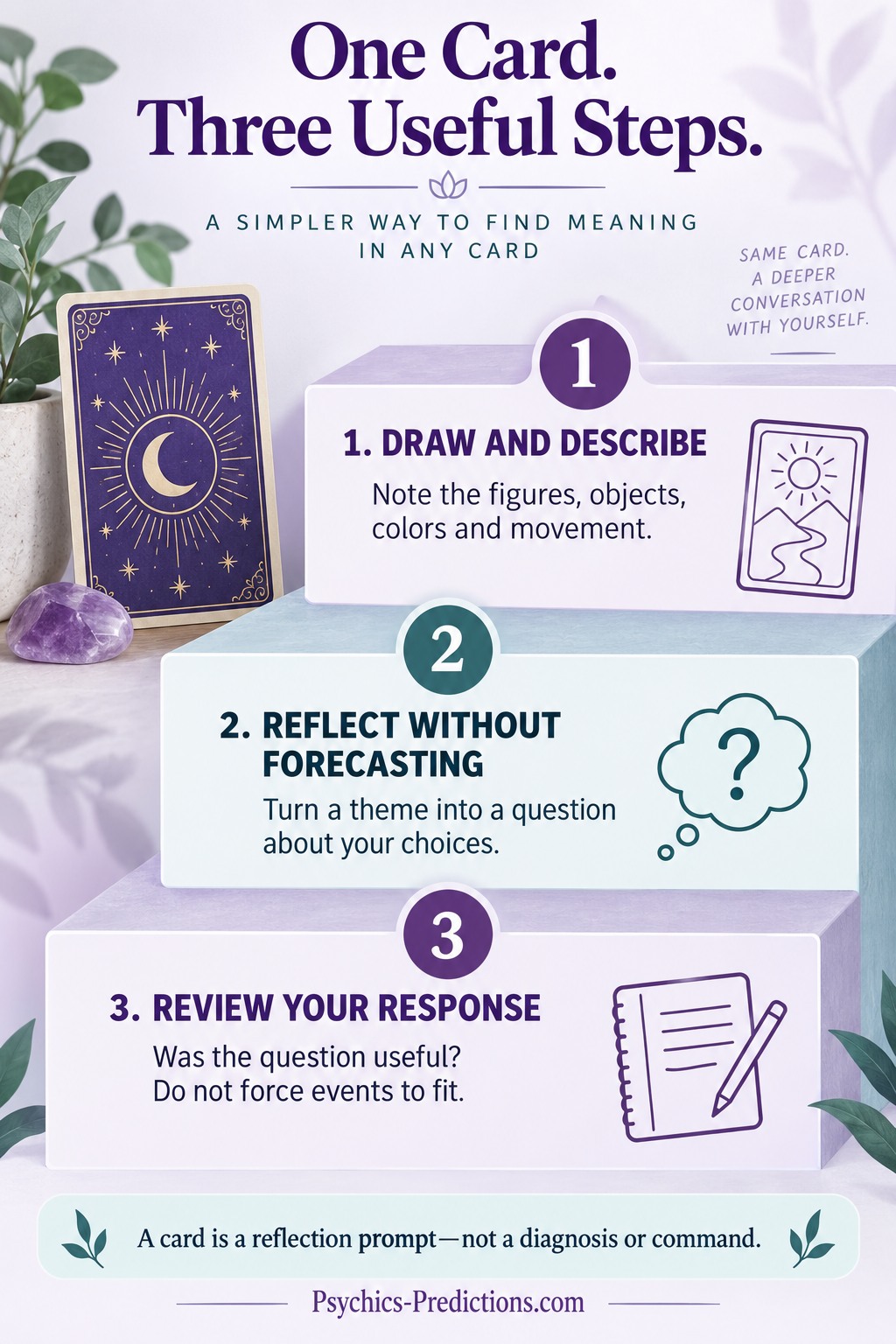
Read the infographic as text
- DRAW AND DESCRIBE
Note the figures, objects, colors and movement.
- REFLECT WITHOUT FORECASTING
Turn a theme into a question about your choices.
- REVIEW YOUR RESPONSE
Was the question useful? Do not force events to fit.
A card is a reflection prompt—not a diagnosis or command.
Better questions for a daily exercise
- What task deserves a little more attention?
- Which assumption could I check rather than take for granted?
- What boundary would make my day more manageable?
- What do I already know about this decision?
- What small action is available to me without relying on a prediction?
Avoid treating “Will I get the job?” or “Is my partner lying?” as questions a card can settle. For consequential choices, use our prediction safety guide to separate an interpretation from evidence.
Keep a clear journal
| Record | Example | Keep separate |
|---|---|---|
| Visible details | “A figure holds several objects.” | What the image actually depicts |
| Symbolic theme | “The guidebook discusses responsibility.” | An interpretation, not a finding about your life |
| Reflection question | “Which responsibility needs a clearer limit?” | A prompt you chose |
| Practical response | “I will ask to clarify a deadline.” | An action you decide for ordinary reasons |
| Later review | “The conversation clarified the task.” | What happened, without claiming the card caused it |
If you make an actual prediction, record its exact wording before the event and include misses. Our record-keeping guide explains why a memorable match alone is not an accuracy measurement.
Do not let a frightening card become a threat
The Tower, Death or a difficult-looking suit card can be visually intense. You can study the symbolism without treating it as a warning of illness, violence or death. See our guide to Death-card symbolism and limits if that image has worried you.
You are allowed to put the deck away. No card requires another reading, a paid ritual or a purchase to prevent harm. A helpful practice should not make you afraid to continue ordinary activities.
Card count and chance: correct the basics
A standard deck has 78 cards, not 72. If you draw one card ideally at random from the complete deck, each individual card has the same chance of being selected: 1 in 78. Some methods of shuffling or selecting may not be perfectly random, but a list of “important” cards does not make those cards inherently more likely to appear.
Repeating a card can feel significant; it still does not establish a message from an external source. Record the method and the wider sequence if you want to examine the pattern, rather than only remembering the repeats.
Make room for life outside the deck
Choose one manageable reflection, then return to your day. You do not need a second deck, a larger spread or repeated reassurance to make the first exercise count. If the practice becomes distressing or feels necessary before every decision, pause and seek appropriate support if needed.
If a card raises a relationship question, ask the person rather than assigning hidden motives. Our guide to clear relationship requests offers practical language for that conversation.
Frequently asked questions
1. Do I need to pull a tarot card every day?
No. Choose a schedule that fits your interest and life. Skipping a day does not create bad luck or cancel progress.
2. What can a daily pull help me practice?
It can provide a routine for studying artwork, learning a deck’s interpretive conventions and writing reflection prompts. That is different from establishing predictive ability.
3. How many cards are in a standard tarot deck?
A standard tarot deck has 78 cards: 22 Major Arcana and 56 Minor Arcana. Some creative decks differ, so check your deck’s guidebook.
4. What question should I ask?
Use a question about your own attention or choices, such as “What could I give more thought to today?” Avoid treating the pull as a factual answer about another person.
5. Should I draw one card or several?
One is enough for a short study exercise. More cards add interpretive complexity, not necessarily more reliable information.
6. What if I draw the Tower or Death?
You do not need to treat either card as a forecast of catastrophe or death. Look at its imagery and the deck’s symbolic interpretation, then return to what you know independently.
7. Does a positive card guarantee a good day?
No. The Sun or another encouraging card is not a guarantee of success, safety or good news.
8. Must I read reversed cards?
No. Choose an approach before drawing and use your deck’s instructions if helpful. A reversed card is not an objective diagnosis or warning.
9. Can I redraw until I get a better card?
For learning, you can study any card. For a daily reflection routine, repeated redraws may encourage reassurance-seeking. Consider stopping rather than searching for a preferred answer.
10. How long should I spend?
A brief session is enough if you find it useful. Set a comfortable limit and stop when the exercise becomes repetitive or upsetting.
11. What should a journal include?
Record the date, card, visible details, chosen interpretation, reflection question and any action you considered. Separate what the picture suggests from facts you already know.
12. Are some cards more likely to appear?
In an ideal random draw from a complete standard deck, each individual card has the same one-in-78 chance. Shuffling and selection methods can affect practical randomness.
13. Can tarot confirm that my partner is hiding something?
No. A card cannot establish another person’s private thoughts or conduct. Use communication and observable evidence rather than an accusation based on a pull.
14. Should I make health or money decisions from a card?
No. Use relevant evidence and qualified professional support. Tarot is not a diagnostic test or a financial forecast.
15. When should I take a break?
Pause if you feel unable to decide without cards, keep redrawing for reassurance or become distressed by meanings. Persistent distress deserves appropriate support, not more predictions.
(Sigh) Another article trying to make tarot reading sound profound. It’s just cards, people! Get real. 🙄
“Learning about the cards? Sounds like an expensive game of charades to me!” 😂
Honestly, this just sounds like a way to sell more tarot decks. Do people really think pulling cards daily will change their lives?
This article provides a great overview of how daily tarot pulls can foster personal growth and self-reflection. Highly informative! 📚
I absolutely love the idea of daily tarot readings! They bring such clarity and positivity to my day! 🌞
‘Quality over quantity’ is a valid point, but isn’t it just easier to do both? I think daily pulls can serve different purposes for everyone.
‘Easier’ doesn’t always mean better. Sometimes less is more when it comes to spiritual practices.
“Pulling the Ace of Cups for creativity sounds inspiring! I’m definitely going to give daily pulls a try.” 🌈
I agree! The emphasis on intention makes a huge difference in how effective the readings are.
*Daily Tarot Reading: Just like your morning coffee, but with extra mysticism!* ☕🔮