


Not getting what you want does not prove that the universe rejected your goal or that you failed a spiritual test. Before deciding what a setback means, review the goal, the available resources and the parts of the situation you can actually influence.
You may use spiritual reflection to consider your values. Keep it separate from guarantees about jobs, relationships, health or family plans. An outcome can remain uncertain even when you prepare thoughtfully.
1. Make the goal concrete
“I want success” leaves many questions open. “I want to compare two training options before applying” gives you a task. Write what you want, what it would change and which first step you can attempt.
Distinguish your action from the outcome you hope follows. You can prepare an application; you cannot make an employer choose you. A plan should recognize both.
2. Clarify the reason without judging your worth
Ask what the goal offers: interest, stability, connection, recognition or something else. Mixed motives are not proof that your “ego” is blocking a reward. You can examine a wish without declaring it spiritually impure.
If a goal no longer fits your priorities, revise it. If it does fit, that still does not guarantee the result. For a related reflection, see feeling stuck, energy-block beliefs and practical choices.
3. Check resources and constraints
List the next step’s actual requirements: time, access, information, skills, money or support. Identify one gap you can address and any constraint that is outside your control.
Do not treat every barrier as a mindset problem. A limited opportunity, caring commitment or lack of access may require a different route, support or a changed goal. Blaming yourself for a circumstance does not create the missing resource.
4. Separate waiting from something you can do
Some outcomes depend on schedules or decisions elsewhere. Identify what you are waiting for, whether you have reliable information and when it makes sense to follow up. Avoid replacing a real deadline with an assumed “universal timeline.”
In relationships, waiting does not establish that a particular person will eventually want you. Their current wishes and consent matter. Read connection and mutual choice rather than treating patience as a claim on someone else.
5. Test a small action and learn from it
Choose an action that produces useful information: ask a specific question, compare requirements or practice a task. Decide what you want to learn and preserve the result, including an answer you did not hope for.
This is not a lesson your soul must pass. It is a way to reduce a practical uncertainty. The NHS problem-solving guide distinguishes actionable problems from hypothetical worries and describes planning and reviewing practical steps.
6. Set a review point and a limit
Decide when to reassess and what evidence would change your plan. Consider the cost of continuing, including time and attention—not only money. Do not keep investing just to prove perseverance or faith.
You may continue, seek another route, pause or stop. None of those decisions determines your spiritual worth. Persistence is useful only when it respects your circumstances and other people’s boundaries.
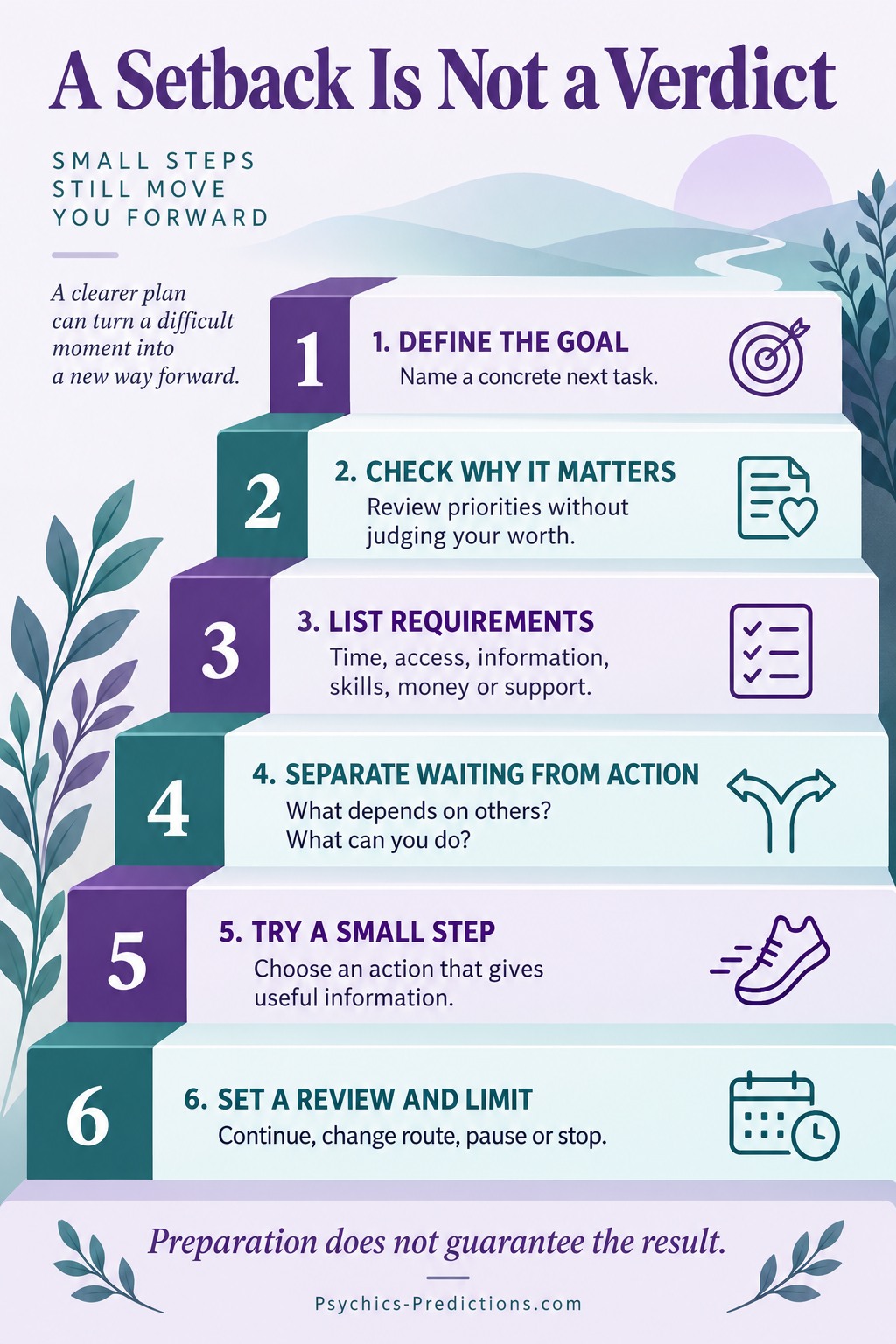
Read the infographic as text
- DEFINE THE GOAL
Name a concrete next task.
- CHECK WHY IT MATTERS
Review priorities without judging your worth.
- LIST REQUIREMENTS
Time, access, information, skills, money or support.
- SEPARATE WAITING FROM ACTION
What depends on others? What can you do?
- TRY A SMALL STEP
Choose an action that gives useful information.
- SET A REVIEW AND LIMIT
Continue, change route, pause or stop.
Preparation does not guarantee the result.
A one-page goal review
| Write down | Example |
|---|---|
| Specific next goal | Compare two courses before choosing whether to apply. |
| Information missing | Entry requirements, schedule and total cost. |
| Action within my control | Request the written details from each provider. |
| What I cannot decide for others | Admission or funding decisions. |
| Review point | After the information arrives, or at my chosen deadline. |
| Limit or alternative | Do not commit beyond my budget; consider another route. |
The example is illustrative, not a recommendation to buy a course or a promise of success.
Keep disappointment separate from a verdict
You do not have to call every rejection a blessing. Nor should fertility difficulties, illness, bereavement or harm be explained as evidence that a soul was not ready or that you wanted something incorrectly. Those situations deserve appropriate practical and professional support.
Allow an honest response to disappointment. Difficult feelings and forced positivity explores why you need not erase an emotion to move forward.
If you consult a reader, keep the question about choices you can examine rather than a guaranteed outcome. A prediction should not replace evidence or push you into urgent spending. Use the prediction safety guide before acting on a consequential claim.
Frequently asked questions
1. Does a setback mean a goal was not meant for me?
No. A setback does not establish destiny or an invisible reason. Review what is known before deciding whether to continue.
2. Are these six checks universal causes of failure?
No. They are planning prompts, not a complete explanation of every setback or a diagnosis of spiritual blocks.
3. Is wanting recognition automatically selfish?
No. Motives can be mixed. Clarify what matters to you without ranking your wishes as spiritually superior or inferior.
4. Can positive thinking guarantee the result?
No. Your preparation and choices can matter, but outcomes may also depend on resources, circumstances and other people.
5. What is a specific goal?
It identifies what you want to do or learn, rather than only a broad state such as becoming successful. Include a next action you can actually attempt.
6. How do I identify a resource gap?
List the time, access, information, skills and support the next step requires. Note which are available and which need an alternative.
7. Does waiting mean the universe is preparing someone for me?
That is a spiritual interpretation, not an established fact. Another person’s interest and consent cannot be assumed from waiting.
8. What if another person says no?
Respect the answer. Persistence toward your own goal does not justify pressure, repeated unwanted contact or overriding consent.
9. Does a skill gap mean I am spiritually unready?
No. A missing qualification or unfamiliar task is a practical issue, not evidence of lower spiritual worth.
10. Should I continue forever?
No. Set a review point and a reasonable limit on time, money and effort. Changing direction can be a considered decision.
11. Is every rejection a hidden blessing?
You may find meaning later, but a rejection does not prove a beneficial hidden plan or require you to feel grateful.
12. Can I change the goal?
Yes. Revise it when your priorities, information or circumstances change. You do not have to preserve a goal merely because you once wanted it.
13. Should a reading decide whether I proceed?
A reading cannot guarantee an outcome. Use independently checkable information and appropriate advice for consequential decisions.
14. What can I do with a worry I cannot act on?
Distinguish it from a practical problem. You can acknowledge uncertainty without inventing a task or paying someone to remove a supposed block.
15. What is a useful next step?
Choose a small action with a clear purpose, record what happens and review the plan. The action need not prove anything about destiny.
“Just wait for the universe’s timeline!” Sure, because sitting around hoping something will happen has always worked out for everyone! Next time I’m in need of a job, I’ll just meditate instead of applying.
*laughs* So basically, if life doesn’t go my way, it’s just the universe telling me I need more lessons? Guess I should start charging tuition fees for all this ‘Earth School’ wisdom!
“You can’t always get what you want…” Is it just me, or does this sound like an excuse for life’s disappointments? A bit of realism wouldn’t hurt here; sometimes a no is just a no!
The concepts presented here align closely with various philosophical teachings on desire and fulfillment. The distinction between ego-driven wants and higher self aspirations is particularly intriguing. It invites deeper contemplation.
This article provides profound insights into the often-overlooked relationship between our desires and spiritual growth. The emphasis on patience resonates deeply with me, reminding us that life’s timing is not ours to dictate.
I find it hard to accept the notion that our desires are preordained or that they might be meant for someone else. Surely, personal ambition plays a crucial role in shaping one’s destiny? This article seems to downplay individual agency.
While I appreciate the intention behind this post, it reeks of spiritual platitudes. Are we really supposed to believe that the universe has a grand plan while we suffer through our unfulfilled desires? Sounds convenient.
(The post rightly emphasizes perseverance.) There’s an undeniable truth in understanding that growth often comes from struggle. This perspective can be quite transformative if one chooses to embrace it fully.