

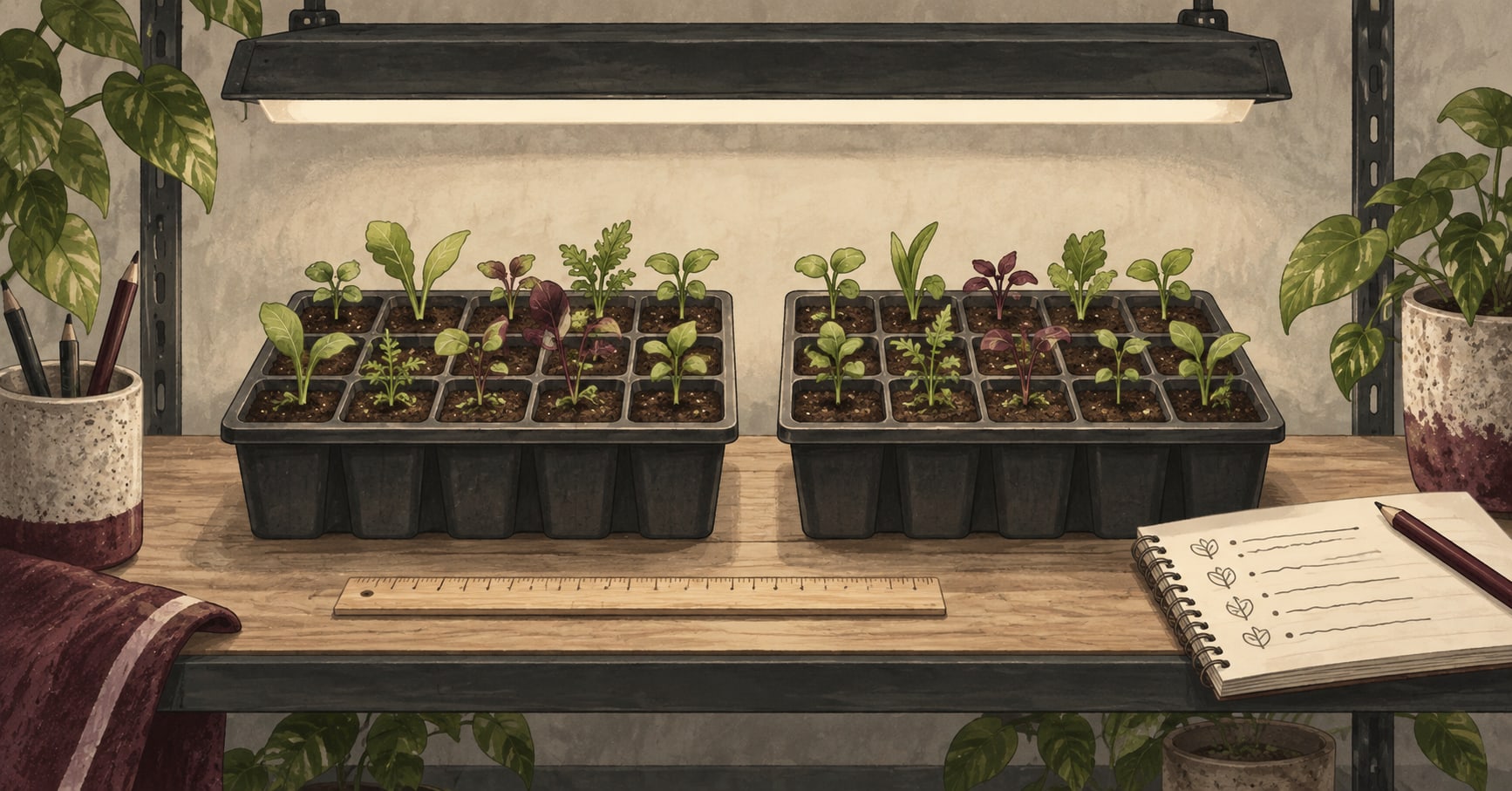
A thriving plant after a Reiki session does not, by itself, show that Reiki caused the growth. A useful comparison separates the proposed intervention from ordinary growing conditions.
You can value a spiritual gardening practice while asking careful questions about its results. This guide helps you evaluate a claim about germination, growth or recovery without turning an attractive photograph into proof.
First identify the kind of evidence
Anecdote
A gardener reports an experience. The cause remains uncertain.
Comparison
A described method records outcomes for comparable groups, including failures.
Replication
Independent investigators repeat the method and examine whether the result holds.
Look for measurements, a comparison group and enough detail to assess the method. Testimonials, an instructor’s confidence and a course advertisement cannot supply missing evidence. Ask what changed besides the proposed Reiki session.
Check ordinary plant care before a special explanation
The University of Minnesota Extension’s seed-starting guide describes the roles of suitable light, moisture, drainage, warmth, seed age and species-specific instructions. These belong in the record for any comparison.
Two nearby trays are not automatically equivalent. Note seed source, handling, position and care. Height alone is not a complete health measure: insufficient light can produce elongated, weak seedlings.
Choose a measurable claim before starting
| Claim | Outcome to define | Record for both groups |
|---|---|---|
| More seeds germinate | Germinated seeds divided by all seeds planted, at a fixed day | Every seed, including failures and missing observations |
| Growth is faster | A specified measurement on the same schedule | Starting measurements, method and conditions |
| Plants survive better | Survival at a stated endpoint | All plants included at the start and any losses |
A five-part evidence checklist
- Define the outcome and recording dates first. Avoid changing the question after results appear.
- Keep the groups comparable. Document ordinary care and any departures from the plan.
- Reduce selection and expectation effects. Random assignment and an observer unaware of group labels can help.
- Report the full record. Include unsuccessful seeds, unchanged plants and missing measurements.
- Look for independent repetition. One favorable batch is not enough to establish a dependable effect.
This is a claim-assessment checklist, not a complete research protocol. An informal household exercise can teach observation without establishing a new biological mechanism.
Keep the source and conclusion in the same scope
NCCIH’s Reiki overview states that there is no scientific evidence supporting the proposed energy field. Its discussion concerns human health, not a review of plant-growth trials. Do not present it as a test of one gardener’s seeds.
In the other direction, a plant anecdote cannot demonstrate treatment of human illness. Match the conclusion to the claim, population, measurement and quality of the actual evidence.
Choose an ordinary next step
If you enjoy a quiet ritual near your plants, continue their normal care. Avoid promises of disease treatment or guaranteed harvests. Seek suitable horticultural help for an unhealthy plant rather than waiting for an energy session to solve the problem.
For related tools, read planning goals without relying on a prediction, checking accuracy claims and the limits of predictions.
Frequently asked questions
1. Does a healthier plant prove that Reiki worked?
No. A change in growth can have several explanations. Compare the conditions and all the results before attributing a difference to the session.
2. Is a gardener’s testimonial the same as a controlled study?
No. It describes an experience. Without a clear method, comparable groups and measurements, it cannot isolate what caused the outcome.
3. Which growth outcome should I record?
Choose a specific outcome before starting, such as how many seeds germinate by a set day or how many seedlings survive. Do not switch the outcome after seeing the results.
4. How do I calculate germination percentage?
Divide the number of germinated seeds by the number planted, then multiply by 100. For example, 8 germinated seeds out of 10 planted is 80%; that calculation alone does not identify the cause.
5. Does a taller seedling always mean a healthier seedling?
No. Height is only one measurement. The linked Extension guide explains that insufficient light can produce elongated, weak seedlings.
6. What should stay consistent between comparison groups?
Use the same seed source, containers, medium and ordinary care, and record the conditions. Differences between groups can provide alternative explanations.
7. Why record where the trays are placed?
Their positions may expose them to different conditions. Note placement instead of assuming two nearby trays receive identical care and light.
8. Why decide the measurement day in advance?
A fixed date limits the temptation to select whichever day makes a result look most favorable. Use the same schedule for both groups.
9. Can I leave failed seeds out of my results?
No. Include every seed planted, with missing observations identified separately. Leaving failures out can distort the comparison.
10. What is the purpose of random assignment?
It reduces the opportunity to deliberately select the strongest seeds or most favorable positions for one group. It does not remove every possible source of bias.
11. What does a blinded observer do?
A blinded observer measures the plants without knowing which group received the proposed intervention. This can reduce expectation-driven differences in recording.
12. Can a few household pots establish a new biological mechanism?
No. They can support a learning exercise, but a convincing mechanism claim needs much stronger methods and independently reproducible evidence.
13. Does NCCIH’s Reiki page review plant-growth trials?
No. The linked overview concerns Reiki and human health. Its statement about the proposed energy field should not be represented as a test of a particular garden.
14. Can a plant-growth anecdote show that Reiki treats people?
No. Evidence about one claimed outcome does not establish a different claim involving human illness. Keep the population and outcome separate.
15. Can I keep a personal gardening ritual?
You can choose a quiet ritual for personal meaning while maintaining ordinary plant care. Do not describe the ritual as proven disease treatment or a guaranteed way to improve a harvest.
This article beautifully encapsulates the intersection of spirituality and horticulture. The idea that Reiki can foster plant growth is not only intriguing but also expands our understanding of energy in nature. I applaud the authors for shedding light on such an innovative practice.
*So you’re telling me that if I give my ferns a little energy hug, they’ll grow faster?* Sign me up! Next thing you know, we’ll be having deep conversations with daisies about their life goals!
“Reiki therapy for trees?” This is a unique concept that underscores how interconnected we are with our environment. It’s essential to consider all avenues when caring for our green friends, as they play such a vital role in our ecosystem.
I have personally experienced the benefits of Reiki on my plants! After incorporating these techniques, my garden has flourished in ways I never expected. It’s wonderful to see more awareness being brought to holistic approaches like this!
*Reiki for plants?* What’s next, tarot reading for tomatoes? It sounds like a delightful blend of fantasy and gardening! Maybe I should try singing opera to my succulents—who knows what might happen!
“The proof is in the pudding”—unless it’s pudding made from magical beans! Let’s not kid ourselves; plants thrive on sunlight and water, not mystical hand-waving. Perhaps we should leave gardening to gardeners and keep the Reiki at yoga class?
While I appreciate the enthusiasm for alternative methods, this article reads more like a pseudoscientific pamphlet than a credible source. The lack of empirical evidence supporting these claims is disheartening. Where are the rigorous studies to back this up?
As someone deeply invested in botany, I find this discussion on Reiki’s application to plant care fascinating. Although unconventional, it raises interesting questions about energetic interactions within living organisms. However, rigorous scientific scrutiny is necessary to validate these practices.