

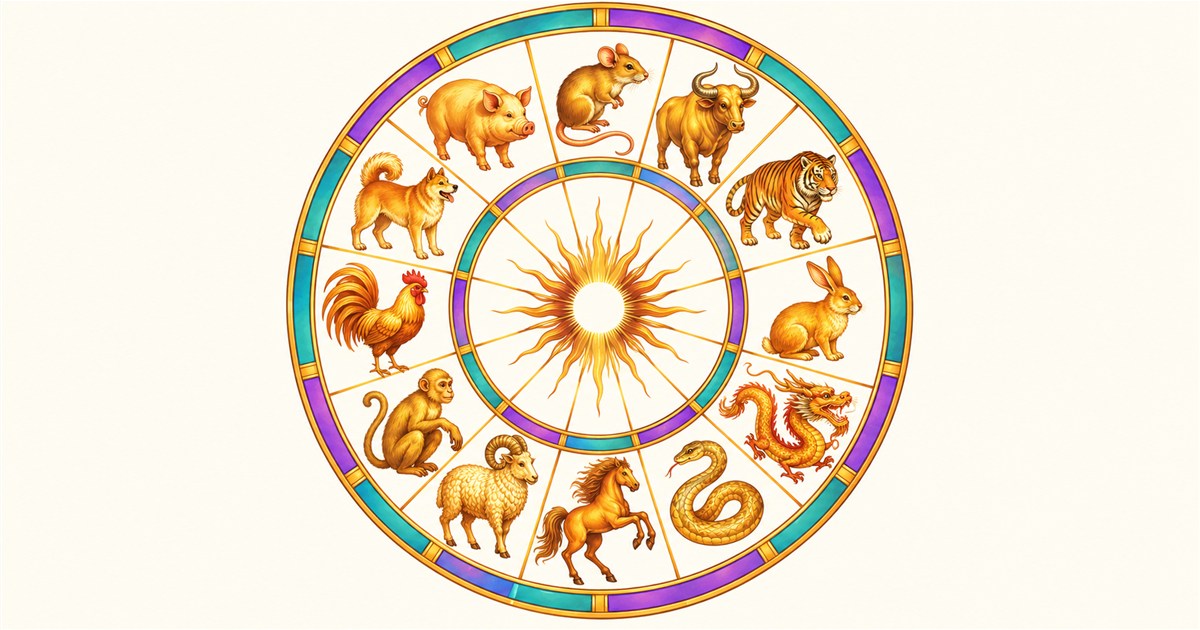
This is a historical guide to the Chinese-zodiac themes used in a March 2017 article—not a current horoscope. The original text attached personal outcomes to particular dates. Those promises should not be treated as reliable forecasts of your relationships, health or success.
The zodiac can be explored as a cultural tradition and a source of optional reflection. Keep three questions separate: what calendar date is being described, what symbolism is being used and what evidence supports a claim about an event.
Calendar
A date can be checked against an appropriate conversion table.
Symbolism
An animal motif can carry cultural or personal meaning.
Prediction
A claim about your future needs more than a date and a symbol.
Chinese zodiac context
The Metropolitan Museum’s account of a set of zodiac figures describes the conventional twelve-animal sequence and its connection to calendrical cycles. The sequence runs from Rat through Pig; Sheep is also commonly rendered as Ram in English.
This is not the same system as a Western zodiac wheel showing Aries, Taurus and the other familiar sun signs. Mixing the illustrations without explanation can make a guide harder to understand. The revised cover keeps the earlier wheel motif but now illustrates the Chinese animals.
Check the calendar before interpreting it
The Hong Kong Observatory’s 2017 conversion table identifies a Ding-You year of the Rooster and shows Gregorian dates alongside lunar dates and solar terms. It is useful for date checking—not for validating a personal forecast.
Do not assign an animal year from the Gregorian year alone when a birthday falls near the relevant calendar boundary. Identify the convention and check the date. A year, month and day are also different layers of a calendar; a label applied to one does not automatically apply to all three.
The old article’s descriptive day names and date-specific promises are not carried forward as verified facts. A phrase about a dragon or rabbit may be vivid, but it does not establish how you will feel on a particular afternoon or which decision will succeed.
Twelve reflection prompts without dated promises
These are new editorial prompts, not traditional predictions or validated traits of people born in particular animal years. Use any row that helps you frame a practical question.
| Animal | Reflection question | Small action |
|---|---|---|
| Rat | What information would help me choose between two options? | Write one unanswered question. |
| Ox | Which obligation needs a practical review? | Check its terms or deadline. |
| Tiger | What idea could I express more clearly? | Make a short draft. |
| Rabbit | Who would I like to communicate with respectfully? | Choose a clear, welcome message. |
| Dragon | What goal deserves attention without an exaggerated promise? | Define a realistic next step. |
| Snake | Which assumption should I check? | Find a direct source. |
| Horse | What small task would reduce unfinished work? | Complete one manageable item. |
| Sheep / Ram | Where can I offer support without overcommitting? | State what I can actually do. |
| Monkey | Which creative alternative have I not considered? | Sketch one option. |
| Rooster | What preparation is missing? | List one item to arrange. |
| Dog | Which boundary needs attention? | Describe it in plain words. |
| Pig | What helps me maintain a workable routine? | Choose one repeatable action. |
Keep the outcome separate from the symbol
If a prompt helps you complete a task, you can value that result without claiming the animal caused it. If the prompt does not fit, skip it. You do not need to force your experience into a horoscope or count ordinary events as proof after the fact.
Continue with clearer distinctions
Read birth-month personality claims and research limits for a related example of calendar stereotypes. Explore astrological elements and money reflection without financial forecasts.
If a dated prediction is shaping your decisions, use how to assess it and keep your choices. Historical interest is compatible with clear limits on what a forecast can establish.
Frequently asked questions
1. Is this a current horoscope?
No. It revisits an article originally published in March 2017. The dated forecasts should not be used as guidance for the present.
2. What changed in this revision?
The dated promises and unsupported personal forecasts were replaced with calendar context and optional reflection prompts. The original publication date and URL remain unchanged.
3. What is the Chinese zodiac sequence?
The conventional order is Rat, Ox, Tiger, Rabbit, Dragon, Snake, Horse, Sheep or Ram, Monkey, Rooster, Dog and Pig.
4. Is the Chinese zodiac the same as the Western zodiac?
No. They are different traditions with different calendrical frameworks. A Western sign wheel should not be presented as a Chinese zodiac chart.
5. Does a calendar conversion table prove a horoscope?
No. It helps establish calendar dates. It does not verify claims about a person’s mood, relationships, health or future success.
6. What does the 2017 Hong Kong Observatory table identify?
It identifies 2017 as a Ding-You year of the Rooster and provides Gregorian-to-lunar date conversions and solar terms.
7. Why not use January 1 for every animal-year boundary?
The traditional calendar is not identical to the Gregorian calendar. Check the relevant date conversion and the convention being used, especially near a boundary.
8. Do the animal prompts describe everyone born in that year?
No. They are editorial reflection questions, not validated personality profiles or universal descriptions.
9. Can I use a prompt for a different animal?
Yes. Choose whichever question fits your situation. The animal headings simply organize the exercise.
10. Does an auspicious date guarantee success?
No. A symbolic date cannot guarantee a job, relationship outcome or financial result. Assess the actual circumstances.
11. Should I delay important care because a horoscope says to wait?
No. A horoscope should not override appropriate healthcare or other time-sensitive professional guidance.
12. Can a forecast decide my financial choices?
No. Check actual income, costs, obligations and risks rather than relying on a dated forecast.
13. How can I make a reflection useful?
Write one concrete observation and one manageable action. Review what happened rather than assuming the horoscope explains the result.
14. Can I appreciate zodiac art without accepting predictions?
Yes. Cultural and artistic interest does not require treating personal forecasts as established facts.
15. Where should I go next?
Explore the linked guides on birthday stereotypes, money symbolism and assessing predictions. Keep symbolic interpretation separate from decisions that need evidence.
‘Ground yourself in nature’? How quaint! As if staring at a tree will magically solve my existential dread. But hey, at least I can blame my finances on being an ‘Ox by the Gate’!
What a thought-provoking piece! The correlation between nature and our emotional states is beautifully articulated. It truly emphasizes the importance of grounding ourselves amid chaos. Bravo!
While I appreciate the poetic language, I must question the validity of attributing personality traits to animals in this manner. Is there empirical evidence supporting these claims, or are they merely whimsical musings?
This article provides an intriguing perspective on astrology and its relation to animal symbolism. However, it would benefit from more scientific backing or references to research that corroborates these astrological claims.
‘You’ll talk sense into others as a Rat’? Sounds like classic projection to me! I’m sure we’d all prefer a more dignified animal for such endeavors.
‘Manage mundane tasks as the Horse in the Clouds?’ If only I could gallop away from my responsibilities instead of reading these anthropomorphized metaphors!
Ah yes, because clearly my life choices hinge on whether I’m a ‘Tiger Leaving the Mountain’ or a ‘Rabbit in the Burrow’. What will they think of next? Astrology for spreadsheets?
‘Life is being fired at you point blank’—what an evocative metaphor! It’s fascinating how this piece ties together our animal instincts with personal growth opportunities throughout the month.